NLP Learning Path

Proprietary Learning Paths

Created by Coach Rajiv Sharma — Among the Top 5 Global NLP Thought Leaders

A developmental system, not a course list. Each path builds on the one before — from managing your own state to changing behaviour that lasts — grounded in Neuro-Linguistic Programming and the MARK Model.

Top 5 Global NLP Thought Leader · 850K+ trained · 57 countries

The Philosophy

Mastery Is Process Built in Sequence, Not Randomly

You learn to regulate yourself before you influence others, to read a person before you change anything, and to hold ethics before you hold power. These learning paths follow that order deliberately — so techniques become durable skills, not clever tricks.
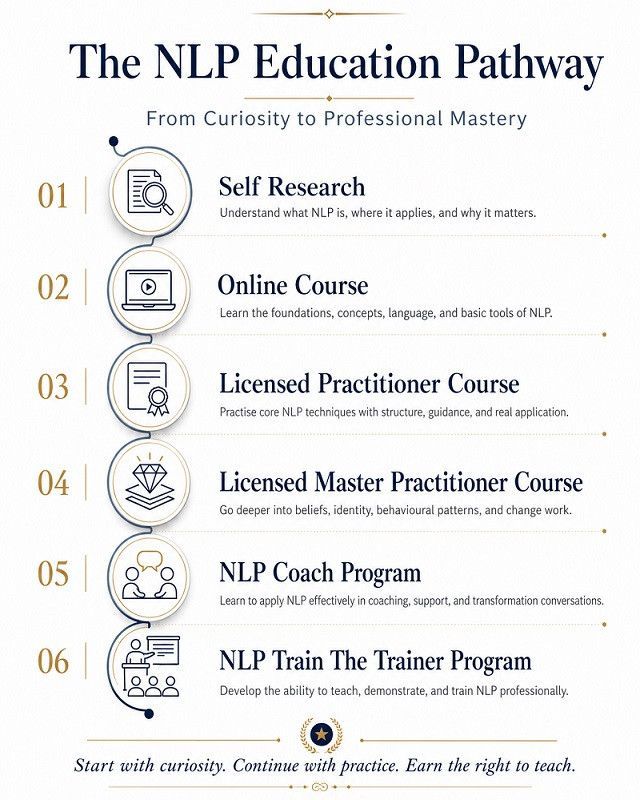
The NLP Education Pathway by Rajiv Sharma
The NLP Education Pathway, by Rajiv Sharma
01

Foundation

The Beginner's Learning Path

Become resourceful on demand and communicate with awareness.

  • Shift your own state deliberately — confidence, calm or focus, on cue.
  • Read another person's state and build genuine rapport.
  • Recognise and gently loosen limiting language in everyday conversation.

Start Here

Begin with a Highly Interactive Online NLP Workshop

The fastest way in. A live, practice-led workshop where you experience the foundational patterns first-hand — state control, anchoring and rapport — rather than just reading about them.

Explore the Online Workshop
1

Manage Yourself

State Management → Anchoring → Submodalities → Swish Pattern

  • State Management — choose your internal state so emotion serves you rather than runs you.
  • Anchoring — fire calm, confidence or focus at will through a learned trigger.
  • Submodalities — the fine controls that turn a state up or down.
  • Swish Pattern — automatically swap an unwanted response for a resourceful one.
2

Understand Others

Sensory Acuity → Rapport → Perceptual Positions → Meta Model

  • Sensory Acuity — read the small cues that reveal an internal state.
  • Rapport — build unconscious trust; the container all influence sits inside.
  • Perceptual Positions — see a situation as self, other and observer.
  • Meta Model — questions that recover the meaning behind vague language.
3

Communicate Change

Reframing → Milton Model → Metaphors → Future Pacing

  • Reframing — change meaning so a new response becomes possible.
  • Milton Model — permissive language that guides attention and lowers resistance.
  • Metaphors — shift beliefs indirectly through story.
  • Future Pacing — rehearse new behaviour so it generalises to real life.
4

Create Lasting Patterns

Well-Formed Outcomes → Strategy Elicitation → Belief Change → Modelling

  • Well-Formed Outcomes — frame goals the whole nervous system can act on.
  • Strategy Elicitation — uncover the internal sequence behind a result.
  • Belief Change — update the limiting beliefs that cap behaviour.
  • Modelling — extract the structure of excellence so it can be reproduced.
NLP for Excellence — the book by Rajiv Sharma

Read First

Request the Book — NLP for Excellence

The core NLP principles for excellence, in Rajiv Sharma's own words — the ideal companion as you begin the foundational paths.

Request the Book
02

Reliability

The Practitioner's Learning Path

Run the foundations cleanly, one to one, under pressure.

  • Shift states — your own and another's — in a live, high-stakes exchange.
  • Calibrate an individual and adapt your language to them in real time.
  • Deliver complete, bounded change techniques safely — and know where your scope ends.
1

Master Your State Under Pressure

Chaining Anchors → Collapsing Anchors → Circle of Excellence → State Interrupts

  • Chaining Anchors — move from a stuck state to a resourceful one, step by step.
  • Collapsing Anchors — neutralise an unwanted state with opposing anchors.
  • Circle of Excellence — step into peak state on demand.
  • State Interrupts — cleanly break unresourceful loops before intervening.
2

Read and Guide Accurately

Calibration → Representational Systems → Eye Accessing Cues → Pacing and Leading

  • Calibration — precise, repeatable reading of one person's cues.
  • Representational Systems — match visual, auditory, kinesthetic and digital processing.
  • Eye Accessing Cues — read eye movement as a signal of thinking.
  • Pacing and Leading — match, then guide, a live interaction.
3

Apply Language for Change

Meta Model Mastery → Milton Model Mastery → Sleight of Mouth → Nested Loops

  • Meta Model Mastery — the full pattern set, fluent, to clarify and loosen thinking.
  • Milton Model Mastery — hypnotic language, smooth and ethical.
  • Sleight of Mouth — conversational reframing inside ordinary dialogue.
  • Nested Loops — open and close loops of attention to deepen uptake.
4

Deliver Complete Techniques

Fast Phobia Pattern → Parts Integration → New Behaviour Generator → SCORE Model

  • Fast Phobia Pattern — reduce a strong conditioned fear response (clinical cases → refer).
  • Parts Integration — resolve internal conflict around a shared positive intention.
  • New Behaviour Generator — install new behaviour through rehearsal and modelling.
  • SCORE Model — organise an intervention: Symptom, Cause, Outcome, Resource, Effect.

The Engine

Every Path Runs on the MARK Model

Mindset, Action, Repetition, Knowledge — Rajiv Sharma's proprietary model that turns a technique learned in a workshop into behaviour that lasts.

Explore the MARK Model
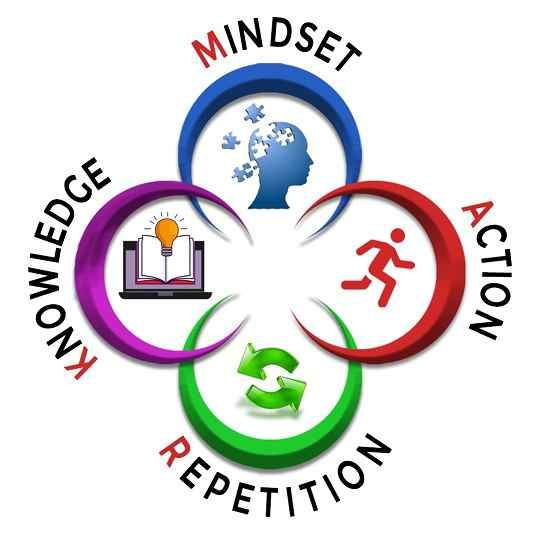
The MARK Model by Rajiv Sharma — Mindset, Action, Repetition, Knowledge
Rajiv Sharma, creator of the NLP Learning Paths

The Creator

Designed by Rajiv Sharma

  • Top 5 Global NLP Thought Leader — Global Gurus, and #3 Sales Trainer worldwide.
  • NLP Master Trainer, personally licensed by Dr. Richard Bandler.
  • ICF Professional Certified Coach (PCC) · 13,000+ hours of executive coaching.
  • Creator of the MARK Model, AI-ENABLE, LeadFORTH & SCOPE frameworks.
  • 850,000+ professionals trained across 57 countries · 900+ corporate clients.
  • Author of Make a MARK in Life & AI-ENABLE for Sales.
Rajiv Sharma — No.1 NLP Trainer & Coach in India →

Beyond the Foundations

The Advanced Pathways

Once the Practitioner path is fluent, mastery deepens and then applies to a context — a relationship, a room, a profession.

Path 03 · Depth

The Master's Learning Path

The structure beneath behaviour: values, filters, identity, modelling.

  1. Understand the Deep Drivers of Behaviour
  2. Work at the Level of Identity and Belief
  3. Design Sophisticated Language and Trance
  4. Model and Design New Patterns
NLP Master Practitioner in India →
Path 04 · The Relationship

The Coach's Learning Path

NLP inside an ethical, client-led, accountable coaching frame.

  1. Build the Coaching Foundation and Relationship
  2. Raise Awareness and Insight
  3. Facilitate Client-Led Change
  4. Sustain Growth and Accountability
Path 05 · The Room

The Trainer's Learning Path

Transmitting NLP live, to a group, at scale.

  1. Master the Trainer's State and Presence
  2. Design Learning That Sticks
  3. Teach and Facilitate Skilfully
  4. Evaluate and Certify
Path 06 · Stewardship

The Master Trainer's Learning Path

Training trainers, designing curricula, protecting the standard.

  1. Model and Codify Training Excellence
  2. Develop Other Trainers
  3. Design at Scale and System Level
  4. Steward the Field and Ethics

Evidence Note

NLP is best approached as a communication, reflection, and behavioural-skills toolkit, not as a medically proven treatment. A systematic review found limited, low-quality evidence for health-related outcomes, so trauma, serious anxiety, depression, phobias, and other clinical conditions should be handled by qualified mental-health professionals.

Your First Step

Start Where You Are — Then Go as Far as You Choose

Begin with the interactive online workshop, request the book, and let us map the right path for you or your team.
Your form has been successfully submitted.
Course will be emailed to you in 24 hours.