01 · ORIGIN
The Story

The Story Behind the MARK Model

The MARK Model was not created in comfort. It was created in recovery.

Coach Rajiv Sharma went through a major business crisis. His companies reached the edge of bankruptcy. The experience forced him to examine success, failure, confidence, discipline and resilience at a depth no classroom produces. When everything you have built comes close to collapse, the questions you ask become different — and the answers you find are real, not theoretical.

Mindset is only the beginning. Action is everything.

As he began rebuilding his life and work, he studied success literature across nearly 100 years. He read more than 100 books — from early personal development classics to modern research on performance, achievement and human change.

One insight kept returning across disciplines, decades and traditions: most people wait for confidence before they act. His experience had taught him the reverse. Productive action, repeated with discipline, can rebuild confidence and reshape mindset. The causation runs in both directions. But for a person standing in the wreckage of a difficult chapter, waiting for the right feeling is a strategy that keeps you still.

He began connecting this with the Law of 10,000 Hours — the principle that mastery is not created by understanding a concept once. It is created by practising a behaviour repeatedly, correcting mistakes, receiving feedback and continuing to improve. A skill does not become natural because a person grasped it intellectually. It becomes natural because the person repeated it until the nervous system stopped resisting.

Around 2013, Rajiv began teaching MARK to small groups. People found it useful not because it was motivational — but because it was honest. It did not ask them to feel differently. It asked them to act differently, repeatedly, until the feeling followed. Companies began using MARK in induction programs, onboarding journeys, graduate trainee development and management trainee programs — because it gave learners a shared language for connecting attitude, behaviour, discipline and performance.

Today, the MARK Model stands as Rajiv Sharma's original NLP-backed framework for turning insight into installed behaviour. Featured in Forbes India. Recognised by Global Gurus. Applied across Fortune 500 companies in 57 countries.

The Business Crisis
Companies near bankruptcy
A real-world crucible that forced examination of confidence, resilience and what actually changes people — not what books say, but what the wreckage of real failure reveals.
100+ Books · 100 Years of Study
The Research
Study of success literature across nearly a century — from early personal development classics to modern performance science. One insight kept returning: insight without action changes nothing.
The Law of 10,000 Hours
The Repetition Principle
Mastery is built through repeated, corrected, refined practice over time — not through understanding alone. The "R" in MARK was born from this finding.
~2013 — First Teaching
MARK Goes Live
Taught to small groups. Adopted by companies. Recognised by Forbes India and Global Gurus. Now applied in 57 countries by 850,000+ professionals.
M
Mindset gives direction.
A
Action creates movement.
R
Repetition builds mastery.
K
Knowledge turns experience into wisdom.
"
MARK is not about positive thinking. It is about productive action repeated long enough to build mastery.
Coach Rajiv Sharma · Creator of the MARK Model®
02 · NLP
NLP Connection

Why MARK Belongs to Practical Neuro Linguistic Programming Work

Neuro Linguistic Programming is often taught through techniques: anchoring, reframing, rapport, language patterns, state management, submodalities and modelling. These tools are genuinely useful. But a deeper question always follows practical NLP work:

How does a person take a new internal shift — produced by an NLP technique — and make it part of daily behaviour?

This is the question MARK was built to answer. MARK gives NLP learners a bridge between awareness and application — moving from internal state to external behaviour, then from repeated behaviour to integrated capability.

M
First Pillar
Mindset connects with beliefs and internal maps

In NLP, people do not respond to reality — they respond to their internal map of reality. Two people face the same rejection. One collapses. One recalibrates. Same event. Different maps. Different behaviour. Different result.

MARK begins with Mindset because no amount of skill, technique or coaching overrides a limiting internal map. The map must shift first — or every new tool gets filtered through the old frame.

The critical insight: Technique without the right internal frame is fragile. A leader who learns a coaching technique but still believes the team cannot think for themselves will unconsciously use the technique to confirm what they already believe.

"A leader who maps disagreement as disrespect will silence the room. A leader who maps it as useful information will invite it. Same situation. Different map. Completely different team culture."
A
Second Pillar
Action connects with behavioural change

NLP is not meant to remain intellectual. If a person changes their internal frame but does not change their observable behaviour, the shift is theoretical. It produces good conversations and no different results.

MARK asks a direct question after every insight: What will you do differently — specifically, measurably, today? Not someday. Not when you feel ready. Today. This is where MARK connects with the strongest insight from motivational frameworks: purpose must precede action, but action must follow immediately.

"A person may speak confidently once in a workshop. That is a controlled experience — not behaviour change. The test is whether they speak confidently in the meeting nobody prepared them for."
R
Third Pillar
Repetition connects with mastery

New behaviour is fragile. One good performance does not create mastery — it creates a memory of possibility. Mastery requires repetition. The Law of 10,000 Hours tells us that excellence is built through repeated practice, correction and refinement.

Neuroscience adds precision: frequency matters more than duration. Brief daily practice builds patterns faster than intensive weekly effort. MARK applies this directly — repetition is where the nervous system, the language system and the identity system reorganise around the new behaviour.

"This is the pillar most development frameworks leave to chance. MARK names it, makes it deliberate and holds the learner accountable to it."
K
Fourth Pillar
Knowledge connects with identity

In MARK, knowledge is not information collected. It is understanding earned — through doing, failing, adjusting and improving. And here is what makes Knowledge the most powerful pillar of the cycle:

Every time a person acts differently, reflects honestly and improves, they accumulate evidence of a new identity. A leader who has given difficult feedback many times, learned and improved — does not just have a feedback skill. They have become a leader who gives feedback. The behaviour has crossed from technique to character.

This upgraded Knowledge creates a stronger Mindset. The next MARK cycle begins at a higher level.

"You do not rise to the level of your goals. You fall to the level of your installed identity. MARK's Knowledge pillar is the mechanism through which a better identity gets installed."
03 · PILLARS
Full Detail

The Four Pillars — Complete Analysis

Each pillar below is explored in full — what it is, why it matters, its NLP alignment, what it builds, and the exact diagnostic questions that make it actionable.

MARK Model Flywheel — Four Pillars Overview
The Flywheel Model

Four Pillars. One Cycle.
Each Revolution Starts Higher.

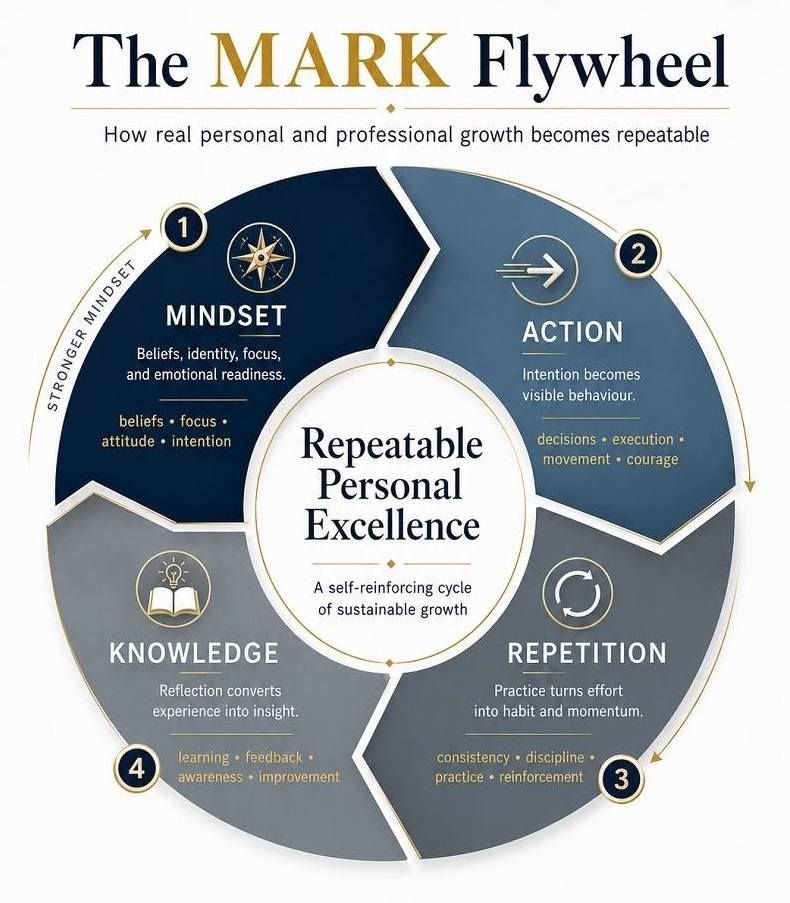
The MARK Model works as a flywheel — not a one-time checklist. Mindset shapes Action. Action builds through Repetition. Repetition earns Knowledge. Knowledge upgrades Mindset for the next cycle.

Remove any one pillar and the flywheel stops. Keep all four and the momentum compounds — each cycle producing a more capable, more grounded version of the person.

M
Mindset
The Starting Frame · Every behaviour is preceded by a belief

Mindset is the meaning system through which you interpret every event, person, setback and opportunity. It is not your mood — mood is temporary. Mindset is the operating frame — the internal map that decides, before you are even conscious of it, what a situation means and how you should respond.

Your mindset decides what you notice and what you filter out. What you attempt and what you avoid before trying. What you believe is possible for someone like you. What stories you tell yourself after a setback.

Two professionals with identical skills but different mindsets produce different results — because their internal maps send them toward different actions. In NLP terms: people do not respond to events. They respond to the meaning they assign to events.

A salesperson with the mindset "customers only care about price" behaves differently from one who thinks "customers care about value, risk, trust and timing." Same product. Same market. Completely different conversations — because of what happens inside the salesperson before the conversation begins.

The critical insight MARK adds to NLP: Technique without the right internal frame is fragile. A leader who learns a coaching technique but still believes the team cannot think for themselves will unconsciously use that technique to confirm their existing belief. The map must shift first — or every new tool gets filtered through the old frame.

Diagnostic Questions
What belief am I operating from in this situation right now?
Is that belief helping me act better — or protecting me from trying?
What would someone with the mindset I want actually believe about this?
What would change in my behaviour if I held that frame instead?
Internal Maps Belief Systems NLP Presuppositions Meaning-Making Identity Frame
A
Action
The Proof of the Shift · Intention without action is autobiography

Action is where mindset becomes visible. This is the most honest part of MARK. A person can claim any belief. Action reveals the belief actually operating beneath the surface.

A leader who says they trust their team but micromanages every decision has told you their real mindset — not with words, but with behaviour. A professional who claims to be committed to growth but avoids the one conversation that would create it has shown you their actual operating frame.

Action does three things nothing else can. It creates evidence — that the new mindset is real, that the new behaviour is possible, that the person they want to become is accessible. It creates momentum — one act of courage makes the next slightly easier. It closes the intention gap — the single most dangerous place in development.

MARK asks two questions together before any action is chosen: Why must this change? (Purpose — the fuel.) And: What will I do differently — specifically — today? (Action — the proof.) Purpose without action produces inspired inaction. Action without purpose loses momentum by day three.

The important question MARK asks after every insight: What specific action will prove that the mindset has shifted? This makes MARK practical in leadership programs, sales training, coaching conversations and personal development work. It converts learning into a visible, measurable behavioural experiment.

Diagnostic Questions
What specific behaviour will prove my mindset has shifted?
What will I do — not plan, not think about — actually do — today?
What am I avoiding that, if I stopped, would change everything?
What would I do right now if I were already the person I am working to become?
Behavioural Proof Intention Gap Well-Formed Outcomes Purpose as Fuel
R
Repetition
The Bridge to Mastery · The pillar most frameworks leave to chance

Repetition is where the real work of change happens. Not insight. Not inspiration. Not intention. Repetition. It is the mechanism through which an occasional action becomes a reliable pattern — available under pressure, accessible without thinking.

Most people can perform a new behaviour once. They can make one strong presentation. Hold one difficult conversation. Ask one better question. Listen deeply in one meeting. The issue is not capability. The issue is continuity.

The world tests your new behaviour the moment the energy of the learning event fades. Old patterns are warm, familiar and well-practised. New patterns are cold, awkward and fragile. Repetition is what makes the new pattern as strong as the old one — and eventually stronger.

Neuroscience is clear: frequency matters more than duration. Brief daily practice builds patterns faster than intensive weekly effort. The Law of 10,000 Hours operates at mastery level — excellence is the product of thousands of repeated, corrected, refined applications — not a flash of insight.

Repetition is not boring routine. It builds: neurological automaticity (the new behaviour stops requiring conscious effort), emotional control (repeated exposure reduces anxiety around the behaviour), skill fluency (the person stops thinking about the technique and begins executing with flow), behavioural consistency, and ultimately identity-level change.

Diagnostic Questions
How many times have I actually practised this — not thought, practised?
What daily or weekly structure will make this happen even without motivation?
What accountability or environment makes the new behaviour easier than the old?
What feedback am I getting that makes each repetition better than the last?
Neurological Automaticity Skill Fluency 10,000 Hours Habit Frequency Identity Change
K
Knowledge
The Upgrade of Identity · What survives pressure is what you actually know

Knowledge in MARK is not information collected. Not what you were taught. Not what you can explain to others. It is what you can apply under pressure. It is what you remember when the conversation becomes difficult. What you use when the objection is unexpected. What guides you when nobody is watching.

Real knowledge in MARK is earned through a specific sequence: you act with a new behaviour; the situation tests it; you reflect on what worked and what did not; you adjust; you repeat with better understanding; over time, the understanding stops being a thought and becomes a capability.

Here is what makes Knowledge the most powerful pillar of the cycle: every time a person acts differently, reflects honestly and improves, they accumulate evidence of a new identity. Not evidence they tell themselves about. Evidence they have lived. A leader who has given difficult feedback many times, learned and improved — does not just have a feedback skill. They have become a leader who gives feedback. The behaviour has crossed from technique to character.

This upgraded Knowledge creates a stronger Mindset. The next MARK cycle begins at a higher level. Each completed cycle does not return you to the starting point. It returns you to a higher version of it. This is the architecture of real development — not a one-time event but a recurring elevation.

Diagnostic Questions
What am I learning from actual experience — not from what I was told?
Where did the new behaviour hold under pressure — and where did it collapse?
What does this experience tell me about who I am becoming?
What must I improve in the next MARK cycle?
Applied Wisdom Identity Accumulation NLP Modelling Lived Experience
04 · CYCLE
The Architecture

The MARK Cycle — A Recurring Elevation

Understanding MARK as a cycle — not a checklist — is essential. Each completed cycle does not return you to the starting point. It returns you to a higher version of the starting point. The framework is designed to spiral upward, not loop flat.

MARK Model Flywheel — Mindset Action Repetition Knowledge — the self-reinforcing cycle of behaviour change by Coach Rajiv Sharma
MARK Model Flywheel — The self-reinforcing cycle of Mindset, Action, Repetition and Knowledge · Coach Rajiv Sharma · NLP Limited
STEP 01
M
Mindset Shapes
Your internal map decides what a situation means before you consciously respond. The frame precedes the behaviour.
STEP 02
A
Action Proves
Your behaviour reveals the actual belief operating — not the one you would claim in a workshop.
STEP 03
R
Repetition Installs
What you repeat becomes the default — accessible without effort, natural rather than forced.
STEP 04
K
Knowledge Upgrades
Earned experience reshapes identity. The next cycle begins higher, faster, stronger.
Each cycle is a complete revolution. Each revolution begins at a higher level.
05 · SCIENCE
Repetition Toward Mastery

The Law of 10,000 Hours and the Case for Repetition

The core finding is clear and honest: mastery is not created by understanding a concept. Mastery is created by practising a skill repeatedly — with attention, correction and genuine effort to improve.

This principle exposes the central weakness of modern development culture. The lie is that attending a program creates mastery. That having an insight creates change. That reading the right book installs new behaviour. None of these things are wrong. They are necessary but insufficient. They are the beginning of the MARK cycle — not the end of it.

The end of the cycle is mastery. Mastery belongs to the person who repeats the right action long enough, with enough honest reflection, to make it automatic. This is where the R in MARK meets the deepest research in performance science.

The practical difference is visible and measurable. A salesperson who practises discovery questions every day for three months sounds categorically different from one who attended a discovery workshop once. A leader who gives feedback weekly, reflects and adjusts — sounds different after six months from one who read a feedback framework. A coach who practises presence in every session develops a depth of hearing no technique teaches.

Repetition is the bridge between a person who knows and a person who can. The Law of 10,000 Hours is the scientific argument for why that bridge must be built deliberately — not left to chance.

🗣️
Communication Skills
Clarity and presence built through repeated real conversations — not rehearsal rooms
🎤
Public Speaking
Confidence that survives adversity — built through repeated exposure, not preparation alone
💼
Sales Conversations
Consultative questioning that sounds natural — built through thousands of real interactions
👥
Leadership Feedback
Honest feedback that lands with care — built through repeated difficult conversations
🧘
Coaching Presence
Depth of hearing that comes from genuine presence practised in every session
🏗️
Emotional Control
Choosing response over reaction — built through repeated, conscious practice under real pressure
"
Mindset matters. But mindset without action becomes self-talk. Action matters. But action without repetition becomes occasional effort. The full cycle needs all four.
MARK Model — The Intellectual Contribution
06 · AI AGE
Relevance Now

Why MARK Is the Most Important Framework in the AI Age

The AI age has made information cheap. Any question answered in seconds. Any framework summarised in minutes. Any skill explained with precision on demand.

And behaviour change is still rare.

The next competitive advantage will not belong to people who know more. It will belong to people who have installed better behaviour through repeated, disciplined, reflected practice.

In a world where content is infinite, MARK brings people back to the only thing that has always created mastery: doing it. Repeatedly. Better each time.

Information is no longer the scarce resource. Installed behaviour is. This is why MARK is more relevant now than when it was created in 2013 — because the gap between knowing and doing has never been wider, and the tools for closing it have never been more necessary.

The person who reads this page compared to the person who applies these four questions to one real situation today — and again tomorrow — these are not the same person one year from now. MARK is the difference between them.

Can ask AI for a sales script in 30 seconds.
Still lacks the courage to make the call — or the consultative mindset to ask the right question when the script runs out.
Can generate a thoughtful feedback template instantly.
Still delays the difficult truth — because the mindset that makes feedback feel safe has not been installed.
Can read 50 coaching frameworks in an afternoon.
Still stays at the surface with a client who needs depth — because presence is not a technique. It is a practised state.
Can create a perfect 90-day productivity plan.
Still repeats the same pattern by day twelve — because the belief generating the old behaviour was never examined.
Can access every leadership model ever published.
Still returns to the same default under pressure — because knowledge not installed through repetition is decoration, not capability.
07 · APPLICATIONS
MARK in Any Field

MARK Model in Any Field, at Any Level

The MARK Model is simple enough for a new employee on day one and deep enough for a senior leader after twenty years. These are not separate versions of the model — it is the same cycle applied with different specificity.

Leadership behaviour begins before the meeting starts — in the leader's internal frame. Every leadership behaviour is preceded by a belief. Most leaders have never examined theirs.

A leader who believes "I must have every answer" will speak more than they listen, decide more than they delegate, and create dependency — all while believing they are being helpful. A leader who believes "my role is to create clarity and responsibility" produces entirely different team behaviour.

Same title. Same team. Different map. Different culture. The MARK Model gives leaders a four-question diagnostic for any leadership situation — not just in a workshop, but in the corridor, after the meeting, before the difficult conversation.

This is leadership development without theatre — removing the performance of appearing to lead and returning the leader to the observable work of leading.

M — Mindset
What belief is actually driving my behaviour here?
Not what I'd say in a workshop. What's operating when pressure is high and the room is difficult.
A — Action
What must I do differently — specifically — this week?
Not eventually. This week. Which conversation, with which person, in which moment.
R — Repetition
What leadership behaviour must I practise until it is no longer an effort?
One good leadership moment is a good day. Repetition makes it an identity.
K — Knowledge
What is this teaching me about myself, my team and my impact?
Leadership knowledge without self-knowledge is incomplete — and eventually, dangerous.

Sales at its lowest level is manipulation. At its highest level, it is applied empathy. The difference is not technique — it is mindset. A salesperson who believes their job is to push a product produces different conversations from one who believes their job is to help a customer make a better decision.

Same product. Same market. Same pricing. Completely different outcomes — because of what happens inside the salesperson before the conversation begins. This is where MARK connects powerfully with NLP-based sales training.

NLP provides the tools: language patterns, rapport, state management, influence through understanding. MARK installs those tools through the one thing that makes any tool permanent: repeated, reflected practice. The difference between a salesperson who sounds scripted and one who sounds natural is not talent — it is repetitions.

M — Mindset
I am here to create value, reduce risk and help the customer decide better.
This is a map — it determines which questions get asked and how objections are heard.
A — Action
Before presenting, I ask enough questions to understand the real problem.
Not an intention — a specific sequence of behaviour that proves the mindset is real.
R — Repetition
I practise discovery and objection handling until they are conversations, not techniques.
Consultative selling is a practised state — not a workshop certificate.
K — Knowledge
After every interaction: what did I learn about this customer and my own pattern?
Sales knowledge without market learning and self-awareness is fragile.

Most coaching conversations produce insight. Fewer produce behaviour change. Very few produce identity-level transformation. The difference lies in what happens between the awareness and the next real-world moment.

MARK gives coaches a four-question structure connecting insight to behaviour, behaviour to practice, and practice to the knowledge that makes the next session start at a higher level. The client does not just leave with awareness — they leave with a mindset examination, a behavioural commitment, a practice structure and a reflection question.

The goal of coaching is not a more insightful client. It is a more capable, self-aware client who no longer needs the coach for this particular challenge.

M — Mindset
What belief or frame is shaping the client's current result?
Not the stated problem — the internal map producing it. A client who says "I cannot delegate" is operating from a belief. Surface it.
A — Action
What specific behaviour will prove the new frame is real?
The conversation is not the change. It is the beginning. The client needs a behavioural experiment to run before the next session.
R — Repetition
What must be practised, how often, until the new behaviour is reliable?
Design the repetition structure together — frequency, context, accountability, reflection checkpoint.
K — Knowledge
What must the client learn to carry this forward independently?
The goal is a client who no longer needs the coach for this challenge.

Corporate training is one of the largest investments organisations make. It is also one of the most poorly retained. Research consistently shows the majority of training content is not applied in the weeks after a workshop. Not because the content was poor. Because no system existed to convert insight into installed behaviour.

MARK solves the post-training problem. It gives every training intervention an after-action structure that participants can apply immediately — without a coach or facilitator present. Four questions asked after every learning event become a practice discipline that outlasts the energy of the workshop.

When an organisation embeds MARK, it gives every individual — from day one to the boardroom — a common system for turning learning into capability. That is culture change with a mechanism, not an aspiration.

M — Mindset
What belief or frame must change for this learning to reach my real behaviour?
Not "what did I learn?" — but "what must I believe differently for this to affect what I actually do?"
A — Action
What specific behaviour will I change, beginning this week?
Not a general application plan. One specific behaviour. One specific context. Beginning this week.
R — Repetition
How often will I practise this — and with what accountability?
Repetition without accountability disappears within days of the workshop ending.
K — Knowledge
What will I capture, share and build on from this experience?
Learning not captured and shared does not compound. MARK turns individual learning into organisational intelligence.

Personal growth fails most often at one precise moment — not at the beginning (when motivation is high) or during the learning (when ideas make sense). It fails at the first test: when life pushes back, the old habit is more comfortable and the new behaviour requires effort nobody is watching.

The MARK Model gives individuals a structure that does not depend on motivation remaining high. It works when energy is low. It works after a setback. It works when the workshop is a distant memory and the real world has reasserted itself.

The mind often follows disciplined action. Waiting to feel ready before acting is a strategy that keeps most people exactly where they are. MARK asks for one productive action today. Then another. Then another. Each repetition is a vote for the person you are becoming.

M — Mindset
What meaning am I giving to this situation right now?
A setback meaning "I was never good enough" leads to retreat. A setback meaning "this is where most people stop" leads to discipline.
A — Action
What is one productive behaviour I can perform today?
Not a plan. Not a decision. A behaviour. Something to physically do today, not someday.
R — Repetition
How will I repeat this behaviour until it is mine?
Until it is part of the evidence of who you are. Every repetition is a vote for a different kind of person.
K — Knowledge
What am I learning from my own experience — not from what I was told?
Real knowledge is what you have earned. What worked, what failed, what you understand now that you did not before you tried.
08 · DIAGNOSTIC
Universal Tool

How to Apply the MARK Model — 4-Step Diagnostic

Apply this after any workshop, coaching session, sales call, leadership conversation, personal decision or moment of challenge. Any field. Any level. Less than ten minutes.

STEP 01
Examine the Mindset
M — Mindset
What belief am I operating from in this situation?
Is that belief helping me act better — or protecting me from trying?
What would a more resourceful frame look like — one someone I respect might hold?
What would change in my behaviour if I held that frame instead?
STEP 02
Choose the Action
A — Action
What specific behaviour will prove my mindset has shifted?
What will I do — not plan, not think — actually do — today?
What am I avoiding that, if I stopped, would create the most movement?
What would I do right now if I were already the person I am working to become?
STEP 03
Build the Repetition
R — Repetition
How many times have I actually practised this — not thought, practised?
What daily or weekly structure will make this happen even without motivation?
What accountability, environment or reminder makes the new behaviour easier?
What feedback makes each repetition better than the last?
STEP 04
Convert to Knowledge
K — Knowledge
What did this experience teach me — from doing it, not thinking about it?
Where did the new behaviour hold under pressure? Where did it collapse?
What does this tell me about who I am becoming?
What must I improve in the next MARK cycle?
09 · TOOL
Practical Application

A Practical MARK Reflection Tool

Use this table after any real experience — a sales call, a leadership moment, a coaching session, a personal challenge. It turns everyday experience into structured learning that feeds the next MARK cycle.

Pillar Reflection Question Sales Context Leadership Context Personal Growth
Mindset
What belief or frame shaped my behaviour in this situation?
"I assumed price was the client's only concern."
"I assumed the team needed direction, not questions."
"I assumed I needed confidence before starting."
Action
What did I actually do — not intend to do?
"I discounted before exploring value."
"I gave answers instead of asking what they thought."
"I waited. I did not start."
Repetition
What pattern am I repeating — and is it serving me?
"I discount too early when the conversation stalls."
"I rescue the team from thinking under time pressure."
"I delay until the moment feels perfect — it never does."
Knowledge
What must I apply from this in the next cycle?
"Ask three value questions before any price conversation."
"Hold the question ten more seconds before speaking."
"Begin with one small action. The feeling follows the doing."
10 · ORGANISATIONS
Corporate Application

MARK Model for Organizations — Beyond the Training Room

Organizations do not change because a training calendar is full. They change when enough people practise better behaviours often enough for those behaviours to become the culture.

The MARK Model gives organizations a shared language for that change. Not a shared workshop. Not a framework on a poster. A shared practice discipline — a common system every individual from day one to the boardroom can use to turn learning into capability.

When MARK is embedded, it gives HR, L&D and business leaders a mechanism for culture change, not an aspiration. The model is simple enough for a new employee on day one — it gives them a way to make sense of every learning experience they will have in the organisation. It is deep enough for a senior leader after twenty years — it gives them a structured way to examine the beliefs driving their behaviour and the habits they have built without examining.

MARK has been applied in induction programs, graduate trainee journeys, management trainee programs, leadership development, sales training, coaching programs and personal effectiveness workshops across organisations and sectors in 57 countries.

🎓
Induction Programs
New employees build the right mindset, work habits and learning discipline from the beginning — not corrected years later.
🌱
Graduate Trainee Programs
Young professionals convert enthusiasm into professional behaviour and accountability with a structure for self-directed development.
⬆️
Management Trainee Programs
Future managers build self-awareness, communication discipline and leadership habits simultaneously.
👔
Leadership Development
Leaders examine the beliefs behind their behaviour — not just the techniques they present in workshops.
📈
Sales Training Programs
Sales teams install consultative habits through repetition and reflection — proving behaviour, not performing in a training room.
🤝
Coaching & Mentoring
Participants move from insight to action to practice to applied knowledge — with a structure they use independently afterward.

Make a MARK in Life

Rajiv Sharma's book Make a MARK in Life expands the philosophy and application of the MARK Model — presenting it as a practical framework for personal and professional growth through Mindset, Action, Repetition and Knowledge.

The book provides a deeper starting point for learners who want to understand the model beyond a page or workshop — with real applications, the personal story behind how the model was built, and the intellectual honesty that makes MARK different from motivational writing.

It is the clearest expression of the simple principle at the heart of MARK: growth is not created by inspiration alone. It is created when better thinking becomes better action, better action becomes repeated behaviour, and repeated behaviour becomes lived knowledge.

📘 Buy on Amazon →
The MARK Model — Final Summary
M
Mindset
Change the internal frame generating the current behaviour.
A
Action
Prove the new frame through a specific, visible, immediate behaviour.
R
Repetition
Practise until it is no longer an effort — until it is an identity.
K
Knowledge
Turn experience into applied wisdom. Begin the next cycle higher.
About the Author
Coach Rajiv Sharma — NLP Master Trainer, Global Gurus #5 (2026), Creator of MARK Model®, LeadFORTH®, AI-ENABLE® and SCOPE®.
rajivsharma.me →
11 · FAQ
Extended Questions

MARK Model — Extended FAQ

The first six questions are answered on the MARK Model overview page. These questions go deeper.

07
Can I apply MARK on my own — without a coach?
Yes. The 4-step diagnostic — examine the mindset, choose the action, build repetition, convert to knowledge — is fully self-applicable. Use it after any significant experience in less than ten minutes. The Reflection Table on this page provides a structured format for each cycle.
08
How is MARK different from habit frameworks like Atomic Habits?
Habit frameworks explain the neurological mechanics of behaviour — cues, cravings, responses, rewards — with scientific precision. MARK adds what they leave out: the meaning system behind behaviour (Mindset) and the wisdom earned through it (Knowledge). MARK also makes Repetition a named, deliberate pillar rather than an assumed outcome of good habit design.
09
What is the Law of 10,000 Hours — and how does it connect to MARK?
The Law of 10,000 Hours is the finding that mastery is built through repeated, corrected, improved practice over thousands of applications — not through understanding alone. It is the scientific and philosophical argument for the R in MARK. Repetition is the bridge between a person who knows and a person who can.
10
Why is MARK especially relevant in the AI age?
The AI age has solved the information problem permanently. The next competitive advantage will not belong to people who know more — it will belong to people who have installed better behaviour through repeated, reflected practice. Information is no longer the scarce resource. Installed behaviour is. MARK addresses precisely that scarcity.
11
What is the intellectual contribution of the MARK Model to NLP?
The MARK Model bridges NLP awareness and daily behaviour installation — the gap NLP practice consistently produces but rarely structures. It answers the question every NLP learner eventually faces: "How do I take what I understood in the room and make it part of who I am?" No other NLP-native framework names all four pillars as equal, in a cycle, with a self-diagnostic tool.
12
Where can I learn MARK in depth — beyond this page?
Through the Licensed NLP Master Practitioner Program by NLP Limited, where MARK is taught as a dedicated curriculum track with specific NLP tools powering each pillar. Also through the book Make a MARK in Life on Amazon, and through NLP Limited's online NLP Foundation Program. Visit markmodel.com or nlplimited.com.
Learn from the Creator

Ready to Apply MARK in Your Work?

The model is on this page. The practice begins in real life. Speak to Coach Rajiv Sharma or begin with the NLP Foundation Program — where every MARK practitioner starts.

Congratulations!

Your form has been successfully submitted.
Course will be emailed to you in 24 hours.