NLP Communication Model - Rajiv Sharma
The NLP Communication Model explains how people turn an external event into behaviour. Between the event and your response sit three filters — deletion, distortion and generalisation — that shape the event into an internal "map." You react to that map, not to reality. Master the filters and you communicate and influence with far more precision.
Two people sit in the same meeting and walk out with two different stories. Neither is lying. Each built a private map of what happened — and then responded to the map. The NLP Communication Model shows you exactly where those maps are made, and how to shape them on purpose.
The NLP Communication Model is a framework that maps how a human being receives information, processes it internally, and produces a response. It sits at the heart of Neuro-Linguistic Programming because it answers a practical question every leader, coach and salesperson faces: why do people react the way they do — and how do I change the reaction?
Its founding premise comes from general semantics: the map is not the territory. We never deal with raw reality. We deal with an edited, simplified version we build in our own minds. Two colleagues, one customer and one event will generate four different maps. Communicate to the map and you connect; ignore it and you collide.
Effective communication and influence follow a nine-stage loop — and it begins before a single word is spoken, with your own state. From there it runs from the outside event, through your senses and your perceptual filters, into the private "map" that creates your state, your physiology and your behaviour. Your behaviour then becomes the next person's external event, and the cycle continues.
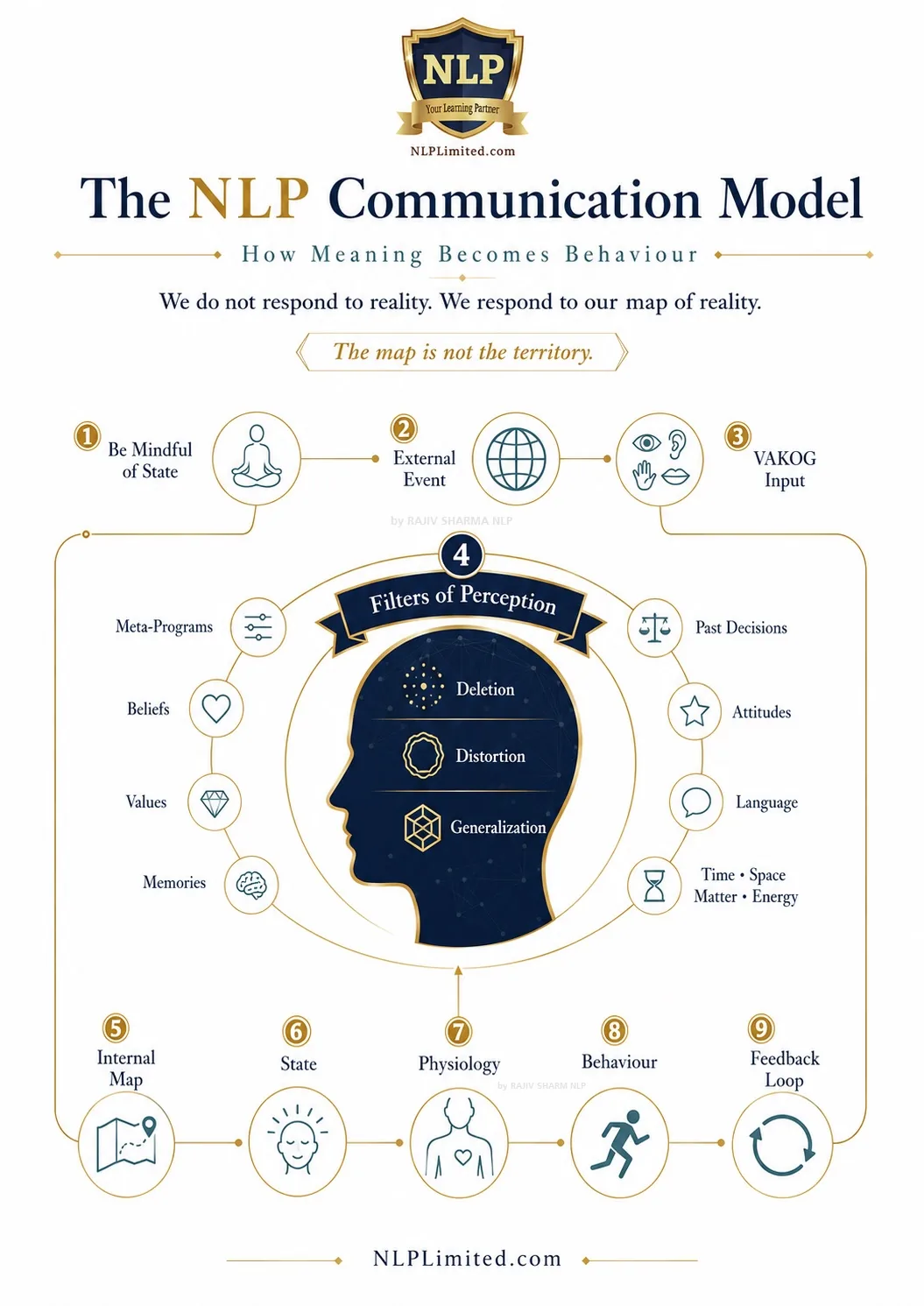
These three filters are how the mind copes with the roughly 2 million bits of sensory data flooding in each second, when conscious attention can hold only about 150 bits of it. They make thinking possible — and they are also where most miscommunication is born.
You leave information out. A manager hears "the client called" and misses "…to thank us." Deletion is why vague instructions create wrong results: the listener fills the gaps with their own map.
You bend information to fit an existing belief. "She didn't reply, so she's annoyed with me." The facts are reshaped into a story — often one that confirms what you already feared or expected.
You turn one example into a rule. "Presentations never go well for me." Generalisation builds skills (you learn one door, you can open all doors) but it also builds limiting beliefs that quietly cap performance.
No — not for most communication. Those figures come from Albert Mehrabian's 1971 book Silent Messages, and they describe one narrow case: how people judge feelings and attitudes when the words and the non-verbal signals contradict each other. Mehrabian himself has stated that unless someone is talking about their feelings or attitudes, the equation does not apply.
The honest takeaway is more useful than the myth: when your words say one thing and your tone or face says another, people believe the tone and the face. Congruence — words, voice and body telling the same story — is what builds trust. That is the real skill, and it is trainable.
Sources: Mehrabian, Silent Messages (1971) and the author's own clarification of his research. See also Big Think's review, "The 7-38-55 rule: debunking the golden ratio of conversation."
NLP gives you two language toolkits that work in opposite directions — both built from the Communication Model.
Introduced by Bandler and Grinder in The Structure of Magic (1975), the Meta Model is a set of precise questions that reverse deletion, distortion and generalisation. When someone says "this never works," you ask "never? what specifically isn't working?" You guide them from a foggy map back to the territory — invaluable for coaching, discovery calls and conflict.
Modelled on the hypnotherapist Milton H. Erickson, the Milton Model does the reverse: it uses deliberately open, permissive language that lets the listener fill in meaning for themselves. Used ethically, it lowers resistance and helps people reach their own "yes" — the language of vision-setting, motivation and influence.
The model is the theory. These are the practices that put it to work in a real room.
Subtly align your posture, pace and breathing with the other person. Research on the "chameleon effect" by Chartrand and Bargh (1999) found that natural mimicry increases liking and makes interactions feel smoother — and in negotiation experiments, pairs in which one person mirrored the other reached agreement far more often, with trust doing the work (Maddux, Mullen & Galinsky, 2008). Done with respect, not mimicry-for-effect, it signals "I'm with you." See the full guide to building rapport →
Notice the small shifts — a change in breathing, a tightened jaw, a drop in tone. These tell you when your message has landed and when it hasn't, often before the other person says a word.
First meet people where they are — their speed, their mood, their language. Once rapport is real, gently lead: slow your pace and theirs tends to follow. Trust is built by pacing before you ever try to lead.
People favour visual, auditory or kinesthetic language. "I see what you mean," "that sounds right," "it feels off." Use the same sensory words they use and your message slots straight into their map.
The frame around a fact changes its meaning. "It's a problem" becomes "it's the feedback we needed." Reframing doesn't deny reality — it offers a more useful angle on it, which is the core move in leadership and negotiation.
When something is vague, recover the detail: who specifically, compared to what, what would have to happen? Precise questions dissolve assumptions and surface the real issue fast.
Before a difficult conversation, decide what you actually want, stated positively and specifically. A clear outcome steadies your state — and your state, as the model shows, drives everything that follows.
The model is sector-neutral, which is why it underpins so much corporate training. In leadership, it explains why the same announcement lands four different ways across a team — and how to frame it so it lands once. In sales, it turns objections into Meta Model questions instead of arguments. In customer service and emotional intelligence, it gives staff a way to manage their own state before it leaks into their tone. The skill underneath all three is the same: notice the map, then shape it with language.
Theory only helps if you can reach for it mid-conversation. Here are three moments that happen every week, and the exact in-the-moment move for each.
1. When someone pushes back or criticises you
Tool: pause 3 seconds → Meta Model questionCriticism triggers a state change before you've even processed the words. Give it three seconds, then ask for the deleted detail instead of defending.
Instead of: "That's not fair — I did everything right."
Try: "Help me understand — what specifically isn't working for you?"
Why it works: it defends nothing, recovers the information deletion hid, and lowers the temperature so you're solving a problem, not winning a point.
2. When someone goes quiet or disengages
Tool: sensory acuity → backtrack in their wordsWatch for the shift — arms fold, eye contact drops, the tone flattens. That's your signal the message hasn't landed. Reflect their own words back before you add yours.
Instead of: pressing on with your next point.
Try: "So the timeline feels tight to you — have I got that right?"
Why it works: people stay in conversations where they feel heard. Backtracking proves you read their map, not just their words — which is what reopens them.
3. When a client or colleague raises an objection
Tool: hold the mirror → reframe price as valueAn objection like "it's too expensive" is an invitation, not a wall. Keep your posture and pace aligned to theirs so trust holds, then move the frame.
Instead of: "No, it's actually really good value."
Try: "So getting real value for the spend matters most — let's look at exactly what that includes."
Why it works: mirroring keeps the trust that mediates agreement (Maddux et al., 2008), and the reframe shifts the conversation from price to value without an argument.
The NLP Communication Model is a framework describing how a person turns an external event into behaviour. The event passes through filters — deletion, distortion and generalisation, plus beliefs, values, memories and language — to form an internal "map." The person then responds to that map, not to the event itself.
It was developed by Richard Bandler and John Grinder, the co-founders of Neuro-Linguistic Programming, in the 1970s. Its central idea — "the map is not the territory" — is drawn from Alfred Korzybski's work in general semantics.
They are the three filters the mind uses to reduce overwhelming sensory input into manageable experience. Deletion leaves information out, distortion bends it to fit a belief, and generalisation turns one example into a rule. They make thinking efficient but are also the main source of miscommunication.
No, not as a general rule. Those figures from Albert Mehrabian's research apply only to judging feelings and attitudes when the verbal and non-verbal signals conflict. The practical lesson is congruence: when words, tone and body agree, people trust the message.
The Meta Model uses precise questions to recover information lost through deletion, distortion and generalisation — moving someone from a vague map back to specifics. The Milton Model does the opposite, using deliberately open language to guide, motivate and reduce resistance.
Practitioners report stronger rapport, clearer questioning and better influence, and supporting ideas like the chameleon effect (Chartrand & Bargh, 1999) show that behavioural mirroring increases liking. NLP is best treated as a practical communication toolkit rather than a clinical therapy, and results come from consistent application.
You can study it through a certified NLP practitioner programme or a focused communication-skills course. NLP Limited runs ICF-aligned NLP training in Dubai and India, where the model is taught alongside rapport, the Meta Model and language patterns for real workplace use.
Turn this model into a skill. Message us on WhatsApp or email — we'll help you pick the right programme.
WhatsApp us Email info@NLPLimited.com