Develop emotional intelligence your leaders and teams will actually use at work. It is measurable EQ — built on Daniel Goleman’s five competencies and the EQ-i 2.0 (Bar-On) model, and made to stick with applied NLP. This Emotional Intelligence Training is delivered in-house in Dubai, Abu Dhabi, UAE and live-online across the world.










Emotional intelligence is no longer just a soft skill — it is a core leadership capability for anyone who wants to manage emotions, communicate better, build trust, and create success in the workplace.
This emotional intelligence training course helps leaders, managers and teams develop the EI skills needed to handle pressure, improve teamwork, strengthen professional relationships, and navigate challenges with clarity and confidence. Across 850,000+ professionals trained in 57 countries, we have seen the same pattern repeat: technical skill opens the door, but emotional intelligence decides what happens once you are in the room.
This training program is grounded in the model popularised by psychologist Daniel Goleman, giving participants a practical understanding of emotional intelligence in the workplace — and of how emotionally intelligent leaders create better results through self-awareness, emotional regulation, empathy, motivation and relationship management. It is led by Rajiv Sharma, an ICF PCC coach certified under Dr. Richard Bandler’s Society of NLP, so the insight is paired with tools participants can apply the same week.
Through focused training sessions and practical exercises aimed at improving emotional intelligence, participants learn to:
The course content covers the essential course topics that support personal and professional success in personal and professional settings. Participants who complete the learning journey earn a blockchain-verified certificate, adding lasting value to their professional development. Individuals and teams can take emotional intelligence training in-house or live online across the UAE.
High IQ helps people solve problems; emotional intelligence helps people work with people. In leadership, that is where real impact begins.
A few of the organisations across banking, insurance, FMCG, industrial, hospitality, technology and government that have trusted NLP Limited with their training and development.





























Emotional intelligence (EI), also known as emotional quotient (EQ), is the ability to recognize and understand your own emotions, manage them well, and read and understand the emotions of others.
The term was popularised by psychologist Daniel Goleman, whose work frames EI around five components: self-awareness, self-regulation, motivation, empathy and social skills.
Why it matters: unlike your intelligence quotient (IQ), which is largely fixed, EQ can be developed at any stage of your career — and it is consistently cited as a stronger predictor of leadership effectiveness and career progression than IQ alone. High emotional intelligence underpins clearer communication, better stress management, stronger interpersonal relationships and the ability to manage your emotions in healthy ways. The World Economic Forum has repeatedly listed emotional intelligence among the core skills for the modern workforce, and research popularised by Goleman and TalentSmart links high EQ to stronger performance, engagement and retention. Our Emotional Intelligence Training is built to develop exactly these skills.
Sources: Daniel Goleman, Emotional Intelligence (1995); World Economic Forum, Future of Jobs reports; TalentSmart EQ research.
In the UAE’s multicultural workplace, emotional intelligence is the clearest line between a competent manager and a leader people choose to follow.
Managing teams across 200+ nationalities, navigating hierarchy, and holding difficult conversations all demand emotional awareness that generic, Western-context courses skip. Across UAE L&D agendas, EI is repeatedly the most-requested development topic for managers and leaders.
Every scenario is set in a UAE multicultural workplace — leading across Emirati, South Asian, European and wider expat teams, not a generic classroom.
Built for the realities of BFSI, government and public sector, aviation and hospitality, healthcare, real estate and professional services — where client trust and team retention are the business.
An EQ baseline, a targeted development plan and behaviour-change indicators — so HR and L&D see the shift, not just a good day in the room.
Wondering how this would land with your teams in Dubai or Abu Dhabi? Let’s talk it through — no pitch, just a useful conversation.
Low emotional intelligence usually shows up as recurring patterns, not one-off bad days.
Common signs in a workplace include:
The encouraging part: every one of these is a skill that can be developed. That is exactly what the training below is built to do.
Low EQ usually shows up first in relationships — missed cues, avoidable friction, trust that never quite forms. Strengthening interpersonal skills is the fastest way to turn that around: as your EQ skills grow, you improve relationships and build stronger relationships across the team, and you make informed decisions with people rather than despite them. The skills gained carry straight into professional and personal life.
Tick the statements that are mostly true of you — your indicative EI score updates as you go. This free emotional intelligence self-check is a quick self-reflection to get you thinking, not one of the formal EQ tests; in the programme we use the validated EQ-i 2.0 for a precise measure.
Your self-check looks at awareness, regulation, empathy and relationship habits — the building blocks of emotional intelligence.
For self-reflection only — not a diagnostic or clinical assessment.
We teach the five EI components recognised across the field and assess against the Bar-On EQ-i 2.0 framework. What makes the change durable is the NLP layer — the practical tools that move a competency from “understood in a workshop” to “used under pressure on Tuesday.”
Recognising your emotions as they happen, naming them accurately, and understanding your triggers, strengths and blind spots.
NLP layer: calibration and sub-modality work to notice and label internal states in real time.
Responding instead of reacting — managing stress, frustration and impulse so emotion informs your judgement rather than hijacking it.
NLP layer: anchoring and state-management techniques to shift state on demand.
Drawing on intrinsic drivers, optimism and resilience to stay focused on goals through setbacks and ambiguity.
NLP layer: outcome framing and values elicitation to align effort with what genuinely matters.
Reading verbal and non-verbal cues, taking another’s perspective, and sensing the emotional temperature of a room across cultures.
NLP layer: rapport-building and perceptual positions to understand others without losing yourself.
Influencing, coaching and resolving conflict — building the high-trust, psychologically safe teams that out-perform.
NLP layer: the Meta Model and reframing for cleaner, more persuasive, lower-friction conversations.
Bring this Emotional Intelligence Training to your leadership team — we’ll map it to your people and your goals.
Emotional intelligence also shapes how you show up. Your social and emotional presentation skills — reading an audience, adjusting your message, and staying composed while you deliver it — are social intelligence in action, and they matter as much in a boardroom as in a one-to-one. For anyone whose career development depends on influence, these are essential skills, not nice-to-haves.
Our Emotional Intelligence Training develops EQ the way any skill is built — through honest assessment, deliberate practice, feedback and reinforcement, not theory alone.
Our programme follows three steps:
Establish an EQ baseline against the EQ-i 2.0 so development is targeted to each person, not generic.
80% experiential — role-plays, peer feedback, mindfulness and NLP tools applied to real UAE workplace scenarios.
The MARK Model® (Mindset, Action, Repetition, Knowledge) and a personal development plan turn insight into habit.
Anchoring, reframing, calibration and rapport give participants tools they can apply the same week — the reason the change holds.
As AI absorbs routine cognitive work, human skills become the premium. Drawing on our AI-ENABLE® approach, we cover leading people through AI-driven change and building psychological safety in hybrid teams.
The MARK Model® and built-in follow-up turn a two-day insight into a sustained behaviour change you can measure.
Reading and listening fade fast. A widely-used learning principle holds that we retain far more of what we say, write and do than what we simply read or hear — which is why roughly 80% of every session is experiential, hands-on practice.
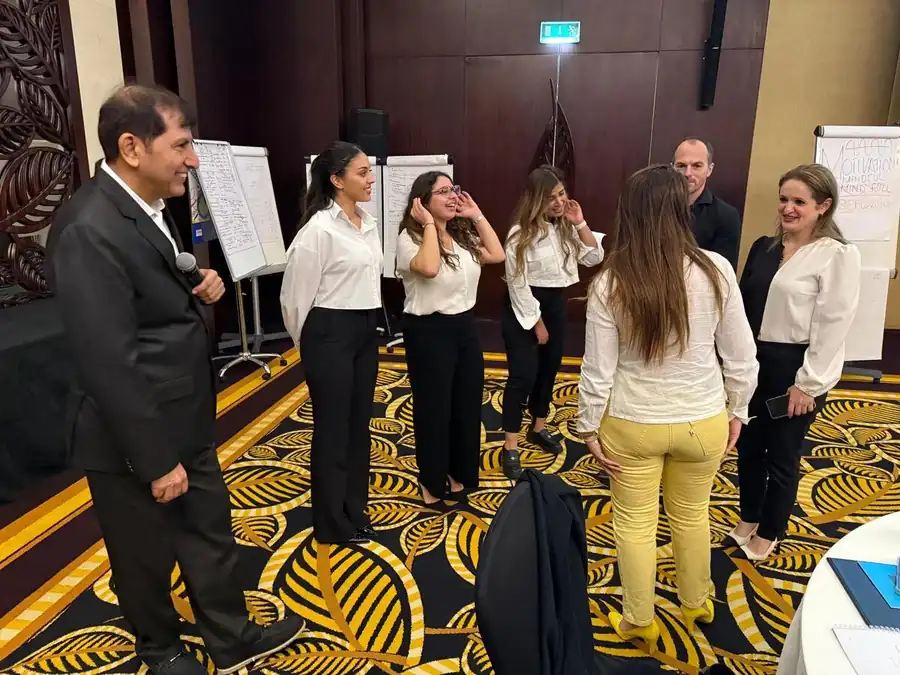

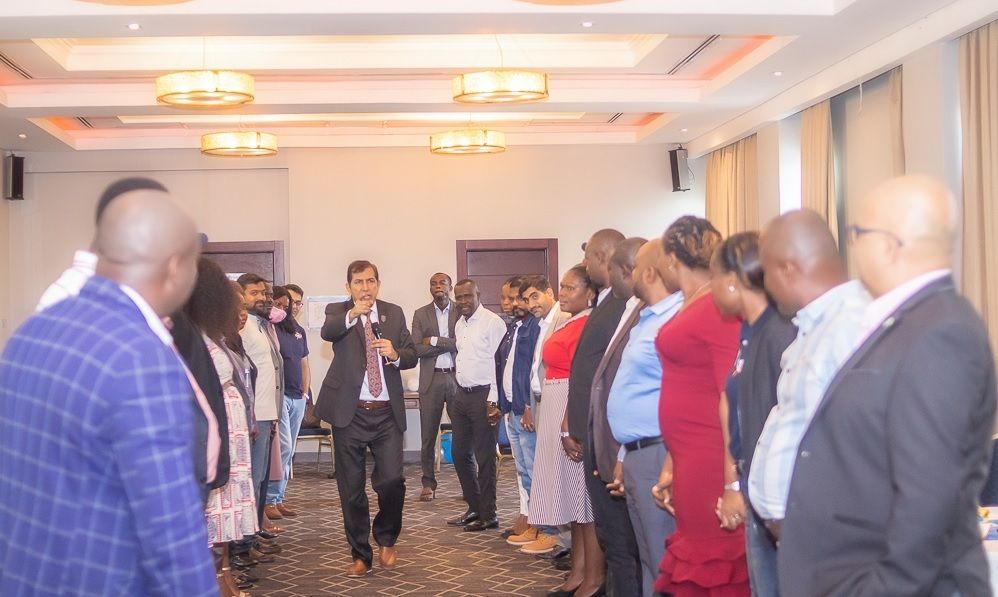

From self-awareness to transformational leadership, the course content spans seven modules of emotional intelligence skills — roughly 80% experiential and each mapped to the EI components above. Delegates build EQ skills they can use immediately: social intelligence to read a room, techniques for managing pressure, and the essential workplace skills that turn knowledge into behaviour. It is practical EI training built for lifelong learning, not one-off theory.
Competencies: Self-Awareness
Competencies: Self-Awareness
Competencies: Self-Regulation · Motivation
Competencies: Empathy
Competencies: Social Skills · Empathy
Competencies: Social Awareness · Self-Regulation
Competencies: All elements, applied to leadership in the AI era
Want the full module-by-module outline and a sample agenda shaped around your team?
Every format of this Emotional Intelligence Training is live and instructor-led, with experiential exercises and peer feedback — because EQ is built by doing, not by listening. All participants receive training materials, a one-to-one coaching session and a blockchain-verified digital certificate. Course fee and dates are shared on request, tailored to your group.
Tell us your team size and goals — we’ll come back with a tailored proposal and the next available batch.
Participants leave able to manage their own emotions under pressure, read and influence others, and build the trust that drives team performance.
Designed for every level of leadership — no prior EQ knowledge required.
Refine the self-awareness, empathy and relationship management that define leadership at C-suite and board-adjacent level.
Sharpen your team management and become the manager people choose to follow — and lift the engagement scores UAE organisations now measure.
Build the credibility that makes your guidance genuinely influential, and embed EQ across the leadership pipeline.
Close the interpersonal gap that limits advancement — critical in the UAE’s relationship-driven business culture.

Founder and lead trainer of NLP Limited, with a 30-year career in leadership coaching, NLP and behaviour change. Rajiv brings the following credentials to every Emotional Intelligence Training programme:
Recognised by Marshall Goldsmith, Brian Tracy, John Mattone and Dr. Richard Bandler.
Our Emotional Intelligence Training is rated 4.9★ across 4,400+ Google reviews, from professionals and teams trained across 57 countries.
Quick answers on what EI is, how it is developed, course topics, certification and corporate delivery in the UAE.
Improving emotional intelligence through a structured training program helps participants:
Send us a message to know the course topics, certificate details, and the next available batch.
Tell us about your people and goals — we’ll respond with a tailored proposal for in-house or live-virtual delivery in the UAE.