1
Find the cause, not the culprit
Reframe the question from "who is being difficult?" to "which two cultural rulebooks just collided?" This single shift takes the heat out and makes the problem solvable.

Conflict management in multicultural teams starts with one shift: look for the cultural cause before the personal one. On a UAE team built from diverse cultural backgrounds, most friction isn't a personality problem — it's a collision between a culture that confronts openly and one that protects harmony. Read that collision correctly, apply a few effective strategies, and the fix is usually quick.

Last updated: June 2026










Conflict management in multicultural teams is the practice of resolving workplace disagreements that arise from cultural differences — differences in communication styles, cultural values, and cultural norms — in a way that protects every person's standing and strengthens the team. Effective conflict management finds the cultural cause before the personal one, hears each side privately, reframes the clash around common ground, and agrees clear conflict resolution strategies so the same collision doesn't repeat.
The managers who do it well treat conflict as information, not threat. At NLP Limited, they're trained to read the cultural logic behind each position and de-escalate with Neuro-Linguistic Programming — calm, rapport, and reframing — so managing conflict in multicultural teams ends in a stronger working relationship, not a lasting fracture.
Most cross-cultural conflict is a misread, not malice — two people from different cultural backgrounds applying different cultural rulebooks to the same situation.
One person sees a missed deadline as a broken promise; the other sees a rigid date as less important than getting the work right. One reads direct disagreement as healthy debate; the other experiences it as a personal attack. Neither is wrong — they're running different cultural software, and those differences in communication styles and cultural values easily lead to misunderstandings. In a workforce drawn from diverse cultural backgrounds, those collisions are frequent, and the cost of mishandling them is real.
Most of it traces to four sources of conflict: communication (direct versus indirect), face (candour versus harmony), hierarchy (attitudes to power distance), and deadlines (differing views of time and expectations). Name which one is in play, and the cultural conflict becomes solvable.
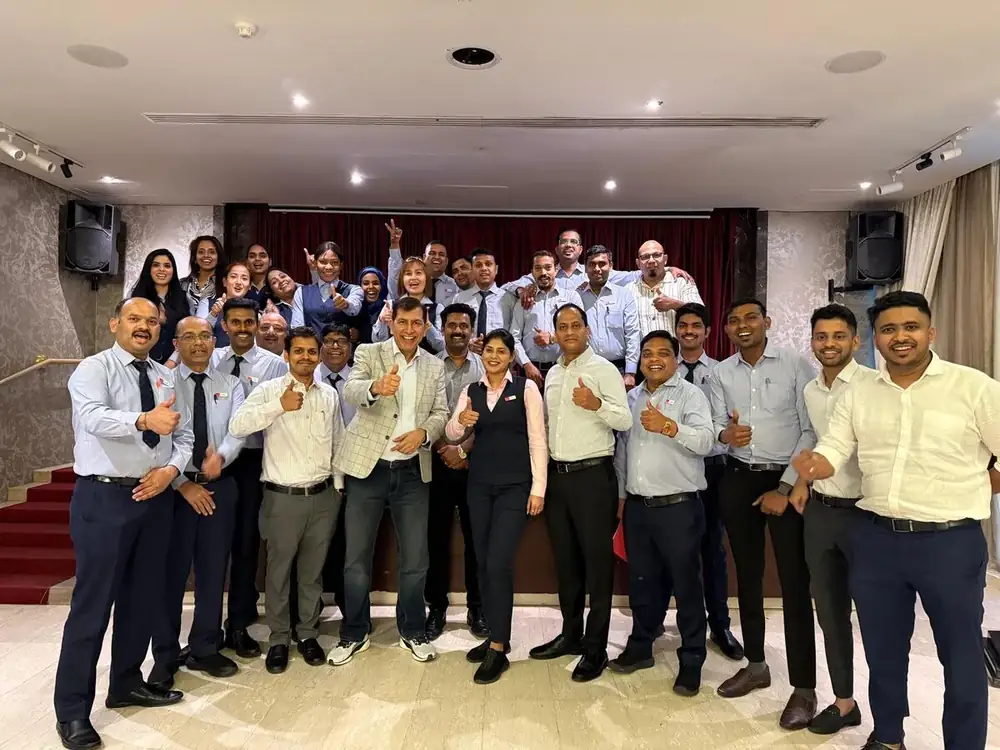
Differences in communication styles are the single biggest source of conflict on diverse teams. In low-context cultures, meaning is in the words: people say exactly what they mean. In high-context cultures, much of the meaning sits in tone, relationship, and what is left unsaid. When a low-context "no problem, let's fix this now" meets a high-context "yes" that really means "I have concerns I can't voice directly," both walk away misreading the other — and the clash looks personal when it is purely about intercultural communication.
Indirect communication, silence, and politeness are easy to mistake for agreement, evasion, or weakness, depending on the listener's own cultural background. The fix is clear communication by design: state intentions explicitly, check understanding rather than assume it, and create open communication channels so a quiet objection surfaces as words rather than as later conflict. Naming the communication style in the room is often enough to stop a misunderstanding from hardening into a dispute.
The clearest model is Conflict Face-Negotiation Theory, developed by Stella Ting-Toomey. Its core idea: in conflict, people are managing face — their public dignity and standing — and cultures differ in whose face they protect. That single difference in cultural values predicts the conflict management style someone brings to a disagreement.
Confront the issue openly and debate it — common in the US, Germany, and Australia, where direct confrontation is seen as healthy problem-solving. Self-face and the outcome lead.
Sidestep open conflict to protect harmony and the other person's face — common across many Asian, Arab, African, and South Asian cultures. Silence is not agreement; it can be unspoken disagreement.
Yield to preserve the relationship and the other's standing. The conflict looks "resolved" but the underlying issue may remain — so check that agreement is real, not just polite.
Many cultures prefer relational give-and-take over time, or bringing in a respected senior to resolve things indirectly rather than a head-to-head confrontation.
These are tendencies, not rules. A direct individual from a harmony-first culture, or a conflict-averse person from a direct one, will break the pattern. Use the model as a first guess, then calibrate to the human in front of you.
Framework: Conflict Face-Negotiation Theory (Ting-Toomey); individualism–collectivism (Hofstede); high- and low-context communication (Hall).
Unconscious bias and stereotypes quietly turn small frictions into real conflict. When someone behaves in a way we don't expect, the mind reaches for a shortcut — often a stereotype about their nationality or culture — and we attribute the behaviour to character ("they're lazy," "they're aggressive") rather than to a different cultural norm. Psychologists call this the fundamental attribution error, and on diverse teams it is the fuel that escalates ordinary disagreements.
Left unchecked, bias also shapes who gets heard, whose ideas are credited, and whose version of events is believed when a dispute arises. The antidote is awareness: naming our assumptions, treating cultural perspectives as different rather than wrong, and inviting the different perspectives in the room before judging. Managers who build that habit defuse conflict before it starts, because they read behaviour as cultural information instead of personal offence.
A six-step structured conflict resolution method that settles the issue and protects both people's standing — so the relationship comes out stronger.
Six steps, in order
Reframe the question from "who is being difficult?" to "which two cultural rulebooks just collided?" This single shift takes the heat out and makes the problem solvable.
Never resolve a cross-cultural conflict in front of others. Give each person a private space where they can be honest without losing standing in front of the team.
Understand each person's cultural logic before bringing them together. Use open questions to surface what each one actually needs — not just their opening position.
Shift both people from defending positions to a common interest — the project, the client, the team. Conflict softens the moment people see the same goal, and common ground, on the other side.
Co-create how they'll work together from here — on deadlines, communication, and disagreement — so the unspoken assumptions that caused the clash become spoken agreements.
Check in a week later. Following up shows both people the resolution was real, and catches any residue before it hardens back into conflict.
A template for the most common case — two team members with different cultural approaches to deadlines. It opens clear, open communication without blame and protects both people's face. Adapt the parts in [brackets].
Hi [Name 1] and [Name 2],
I've noticed we've had some crossed wires on the [project] deadlines recently. From where I sit, it looks like a difference in how we each approach timelines rather than anything personal — and that's an easy thing to sort out together.
Could the three of us take 20 minutes [Thursday at 11am]? I'd like to understand how each of you sees the schedule, agree one shared way of working, and make sure you both have what you need from each other going forward.
I really value what each of you brings to this project, and I'm confident we'll land on an approach that works well for everyone.
Thanks,
[Your name]
Cultural intelligence (CQ) — the framework developed by researchers Christopher Earley and Soon Ang — is a manager's capability to work effectively across cultures. It has four parts: the drive to engage with cultural differences, the knowledge of how cultures vary, the strategy to plan for cross-cultural situations, and the action to adapt behaviour in the moment. Higher CQ is consistently linked to better cross-cultural performance and, crucially, to fewer and milder conflicts.
For a leader, cultural intelligence is what turns cultural awareness into results. It builds the cultural understanding to anticipate where two cultural perspectives will collide, the cultural sensitivity to raise an issue without causing offence, and the skill to bridge cultural differences rather than referee them. Developing cultural intelligence — through cultural intelligence training and real practice — reliably reduces conflict, because managers stop reading difference as defiance.
Neuro-Linguistic Programming gives a manager the in-the-moment skill conflict demands — staying calm, building rapport fast, and reframing a clash into a shared problem. Read across the three letters, each is a distinct advantage in a heated room.
Notice the shift in tone, pace, and expression that signals a conversation heating up — and adjust before it boils over, across any cultural style.
Precise questions move people from blame to interest, and reframing turns "you versus me" into "us versus the problem" — the heart of resolution.
Rehearsed responses keep a manager composed when emotions run high, reinforced as a reliable habit through the MARK Model®.
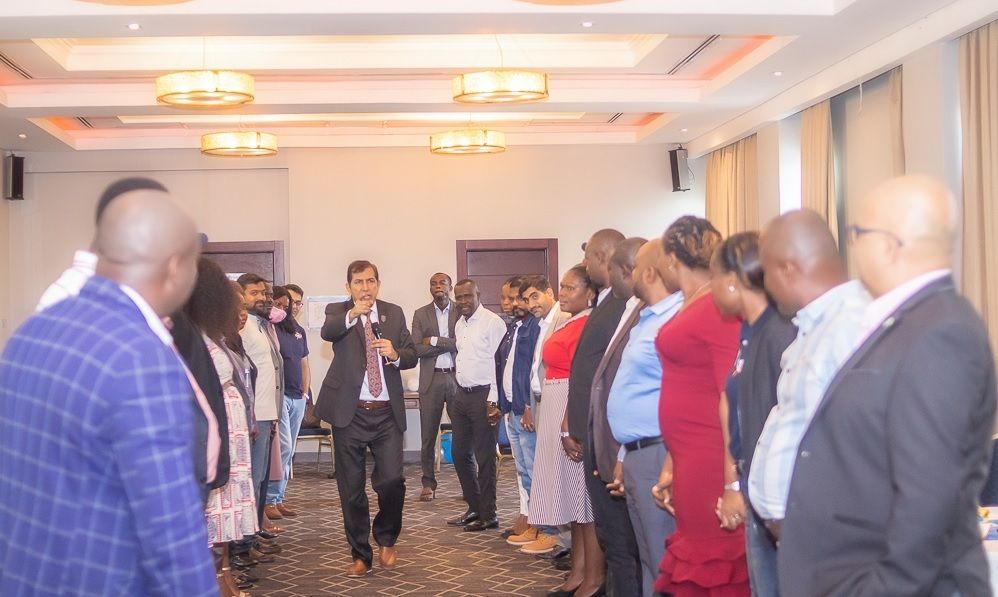
When emotions are high, your job is to lower the temperature before you solve anything. Five moves that work across cultures.
Your steady pace and tone regulate the room. As you stay composed, both people's nervous systems settle toward yours.
Take the conflict out of public view immediately, so no one is performing for an audience or defending their face in front of the team.
Name and validate the emotion before the facts — "I can see this matters to you both." People de-escalate once they feel heard.
Put the issue on the table as a shared object you're all looking at together, rather than something one person is being blamed for.
Anchor on anything you all agree on — the goal, the client, the deadline — and build the resolution out from that common ground.
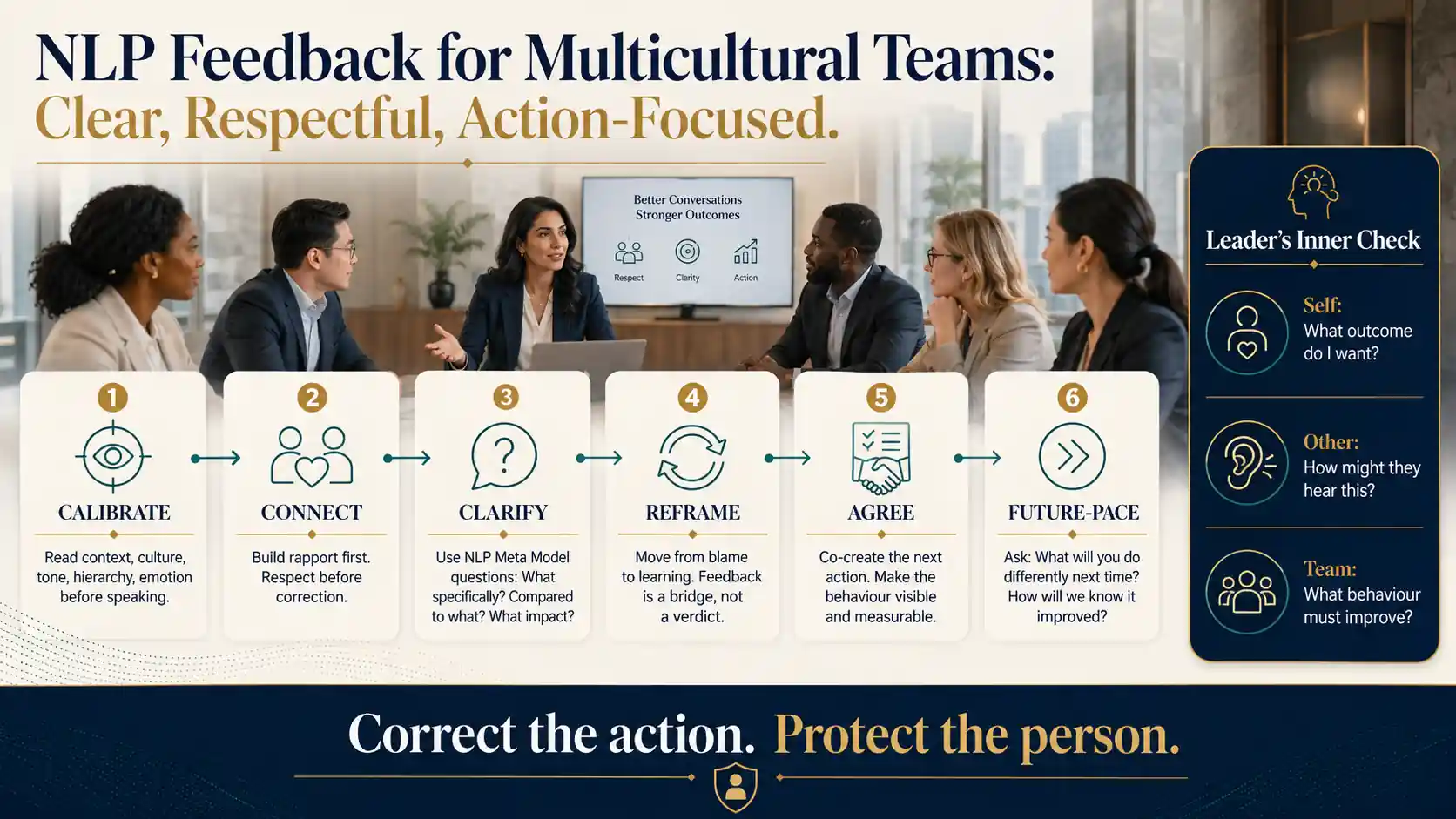
The cheapest conflict is the one that never happens, and prevention is largely an organizational job, not just a manager's. It starts by making the unspoken spoken: set explicit team norms on how people communicate, decide, and disagree, and put deadlines and expectations in writing so cultural assumptions about time never collide silently. Clear communication and open communication channels help prevent conflicts from arising in the first place.
At the organizational level, an inclusive environment is built deliberately — through fair, culturally aware human resource management, cultural sensitivity training, visible respect for every cultural background, and leaders who model respectful disagreement. Build psychological safety so people from different cultural backgrounds raise small frictions early, before they harden. A team that can disagree well rarely needs rescuing from conflict.
Lead with respect for standing and seniority, and keep any correction strictly private — in the UAE, face and hierarchy carry real weight, and a public confrontation can damage trust permanently. Frame the issue around shared goals and visible fairness, apply genuine cultural sensitivity, and where helpful, let a respected senior help resolve things rather than forcing a head-to-head exchange.
Most Emirati–expat friction is a mismatch of expectations between different cultural backgrounds, not a clash of values. Our guide on managing Emirati and expat teams goes deeper on building that trust by design.
| Move | What resolves it | What makes it worse |
|---|---|---|
| Diagnosis | Look for the cultural cause | Label someone "difficult" |
| Setting | Private, face protected | Confronting in front of the team |
| Framing | Us versus the problem | One person versus another |
| "Yes" | Check that agreement is real | Mistake politeness for resolution |
| After | Agree norms and follow up | Assume it's fixed and move on |
Managing conflict in diverse teams well is not about suppressing disagreement — it is about channelling it. Handled this way, conflict in diverse teams is not just contained; it becomes an advantage. Effective conflict management in diverse teams protects the very thing that makes them powerful: the friction of different perspectives, channelled into better decisions instead of lost trust.
Rajiv Sharma has coached managers through cross-cultural conflict in 57 countries — from boardrooms in Dubai and Abu Dhabi to multinational teams across India, Europe, Africa, and the USA. Every step on this page has been used to repair a real working relationship, not just described in a workshop. Three client examples show what changes when friction in diverse teams is handled well.
customer satisfaction at Mercedes-Benz, up from 72%, as diverse teams aligned and friction fell.
NLP Limited client engagementreduction in customer loss at Diners Club, alongside a 254% rise in net production, as teams worked better together.
NLP Limited client engagementmanagers promoted within the year at American Express Asia after multicultural leadership development.
NLP Limited client engagementNLP Limited builds the conflict-resolution skill into your managers — in-house, in Dubai, Abu Dhabi, or virtually. Start with a conversation.
Several kinds of program build the skill of managing cultural conflict: cultural intelligence training (developing CQ across the four capabilities), cultural sensitivity training and cultural awareness workshops, intercultural communication courses, and structured conflict resolution and mediation training. The strongest programs combine a framework with real practice, then embed the new conflict management practices through human resource management policies and ongoing coaching.
NLP Limited's conflict management training does exactly this for UAE organizations — pairing the cultural frameworks on this page with NLP-based de-escalation skill, delivered in-house, in Dubai or Abu Dhabi, or virtually, and reinforced as habit through the MARK Model®. The goal is managers who resolve cultural conflict instinctively, not just managers who have attended a workshop.

Rajiv Sharma is an NLP Master Trainer, ICF Professional Certified Coach (PCC), and founder of NLP Limited. Over 30+ years he has trained 850,000+ professionals across 57 countries, coaching leaders to resolve conflict and lead across cultures. Certified under Dr Richard Bandler's Society of NLP and ranked #5 globally among NLP gurus by Global Gurus (2026), he is endorsed by Marshall Goldsmith, John Mattone, and Brian Tracy. More at RajivSharma.me.
Brian Tracy calls Rajiv "one of the top professional trainers and speakers in the world today."— Brian Tracy

It is the practice of resolving workplace disagreements that arise from cultural differences — in communication styles, cultural values, and cultural norms — in a way that protects every person's standing and strengthens the team. Effective conflict management finds the cultural cause before the personal one, hears each side privately, reframes around common ground, and agrees clear conflict resolution strategies.
Four cultural roots cause most of it: communication (direct versus indirect), face (candour versus harmony), hierarchy (power distance), and differing attitudes to deadlines and time. In a workforce of 200+ nationalities, those differences in cultural background collide often, and most clashes are a misread, not malice.
Differences in communication styles are the biggest source of conflict. Low-context cultures put meaning in the words; high-context cultures put it in tone and what is unsaid. Indirect communication and politeness are easily mistaken for agreement or evasion, so a clash looks personal when it is really about intercultural communication. Clear communication and checking understanding prevent most of it.
Conflict Face-Negotiation Theory shows cultures differ in whose "face" they protect. Individualist cultures tend toward direct, dominating styles and see open confrontation as problem-solving. Collectivist cultures tend toward avoiding, obliging, and compromising to protect harmony. These are tendencies to calibrate, not fixed rules.
A large one. When behaviour surprises us, the mind reaches for a stereotype and blames character rather than a different cultural norm — the fundamental attribution error. Bias also shapes who is heard and believed in a dispute. Naming our assumptions and treating cultural perspectives as different, not wrong, defuses conflict before it escalates.
Use a six-step structured conflict resolution method: find the cultural cause not the culprit, talk privately to protect face, hear each side separately, reframe around a shared goal and common ground, agree explicit working norms, and follow up a week later. The aim is a stronger relationship, not just a truce.
Cultural intelligence (CQ) — drive, knowledge, strategy, and action across cultures — lets a manager anticipate where cultural perspectives will collide, raise issues without offence, and bridge cultural differences. Higher CQ is linked to better cross-cultural performance and fewer conflicts, and it can be developed through cultural intelligence training and practice.
Make the unspoken spoken with explicit norms and written expectations, and build it in at the organizational level through culturally aware human resource management, cultural sensitivity training, and psychological safety so people raise frictions early. Open communication and visible respect for every cultural background help prevent conflicts from arising.
Lead with respect for standing and seniority, keep any correction strictly private, and frame the issue around shared goals and visible fairness with genuine cultural sensitivity. Where helpful, let a respected senior assist rather than forcing a direct confrontation. Most Emirati–expat friction is a mismatch of expectations, not values.
Stronger retention, better communication and collaboration, healthier team dynamics, more innovation from different perspectives, and higher performance. Diversity, led well, is an advantage: companies in the top quartile for ethnic diversity are 36% more likely to outperform on profitability (McKinsey, Diversity Wins, 2020).
Options include cultural intelligence training, cultural sensitivity and awareness workshops, intercultural communication courses, and structured conflict resolution and mediation training. The strongest programs combine a framework with real practice and embed it through coaching — which is how NLP Limited delivers conflict management training for UAE organizations.
Yes. It combines a learnable framework — the cultural roots and resolution steps — with a trainable skill: NLP-based calibration and de-escalation, reinforced until it becomes instinct. That is exactly what NLP Limited builds into managers.
Give hard messages so they motivate, not offend — across any culture.
Open the guide → MulticulturalThe full guide to leading across 200+ nationalities.
Open the guide → MulticulturalBuild the trust where people raise problems before they become conflict.
Open the guide → EmiratisationBuild genuine trust between national and expatriate employees.
Open the guide →We build the conflict-resolution skill into your managers through NLP — so cultural friction ends in trust, not turnover.
Conflict-style descriptions are cultural tendencies observed in research, not rules about individuals; always calibrate to the person. Client outcome figures are from NLP Limited engagements. The MARK Model® is a registered framework of Rajiv Sharma (Govt. of India). Last updated June 2026.
Sources: UAE Ministry of Foreign Affairs (200+ nationalities); UN DESA International Migrant Stock and UAE Federal Competitiveness & Statistics Authority (expatriate share); CPP Global Human Capital Report (2008); Acas, Estimating the Costs of Workplace Conflict (2021); McKinsey & Company, Diversity Wins (2020); Ting-Toomey, S., Conflict Face-Negotiation Theory; Hofstede, G., cultural dimensions; Hall, E. T., high- and low-context communication; Earley, P. C. & Ang, S., Cultural Intelligence.