1
Go first — model fallibility
Admit your own mistakes and uncertainties out loud. The leader sets the ceiling for honesty; if you hide errors, so will everyone else.
Go first. The fastest way to build psychological safety is to admit your own mistake out loud — the moment a leader shows it's safe to be wrong, the team learns it's safe to speak. This isn't a soft nicety: when Google studied its best teams, psychological safety was the single biggest thing that set them apart. On a UAE team of 200+ nationalities and steep hierarchies, it's the hardest — and most valuable — thing a leader can build.

Last updated: June 2026










Psychological safety is the shared belief that a team is safe for interpersonal risk-taking — that you can ask a question, admit a mistake, raise a concern, or challenge an idea without being punished or humiliated. The term was defined by Harvard's Amy Edmondson, whose research found the best teams weren't the ones that made the fewest mistakes, but the ones that felt safe enough to admit them and learn fast.
It is not about being nice, and it is not lowering the bar. It's about candour in both directions — people safe to speak up, and leaders safe to push back. At NLP Limited, that candour is built as a trained skill, because in a high-hierarchy, multicultural workforce it rarely happens by itself.
Because the information a leader most needs — what's going wrong, early — only travels on a team where it's safe to speak.
When people fear looking ignorant, incompetent, or negative, they go quiet. Problems stay hidden until they're expensive, good ideas never surface, and the team that looks "perfect" is often just the one best at hiding its errors. Safety is what turns silence into the early-warning system every business depends on.
Google's Project Aristotle studied 180 teams and found psychological safety the single biggest predictor of team performance — ahead of talent or experience.
Source: Google, Project Aristotleof employees have stayed silent on something important to their manager, fearing the consequences of speaking up.
Source: Edmondson & Detert researchnationalities and steep power distance in the UAE make speaking up across hierarchy and culture especially hard — and especially valuable.
Source: UAE workforce; cross-cultural researchAmy Edmondson's most important point: safety on its own isn't the goal. Cross psychological safety with accountability, and only the high-high quadrant produces a high-performing team.
People feel safe and speak freely, but little gets done with what they say. Pleasant, stable — and quietly stagnant.
The goal. Real pressure and real honesty together — teams surface problems early, learn fast, and perform.
No trust and no standards. People disengage, stay silent, and do the bare minimum to avoid trouble.
High pressure, low trust. People hide concerns and mistakes — and preventable failures follow.
Framework: the learning-zone matrix, Amy Edmondson, The Fearless Organization.
You can read a team's safety in its everyday behaviour. Here's what each side looks like.
| In the room | Psychologically safe | Psychologically unsafe |
|---|---|---|
| Mistakes | Owned early and openly | Hidden until they explode |
| Questions | Asked freely, even "basic" ones | Swallowed to avoid looking unsure |
| Bad news | Reaches the leader fast | Reaches the leader last |
| Disagreement | Voiced and welcomed | Silent nods, then private grumbling |
| Meetings | Many voices, including quiet ones | The senior or loudest voice only |

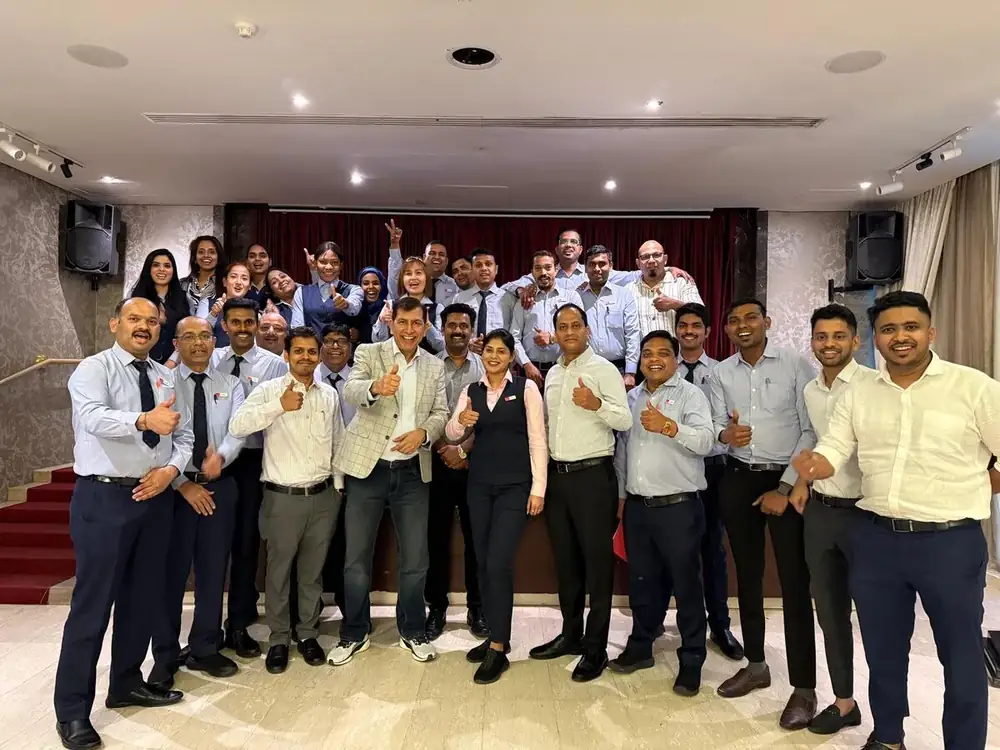
It's harder in the UAE — and that's exactly why it matters more. In a workforce drawn from 200+ nationalities, many people come from high power-distance cultures where challenging a senior is unthinkable, and high-face cultures where admitting a mistake risks deep embarrassment. A blanket "my door is always open" doesn't reach them; silence gets mistaken for agreement, and the most valuable information never surfaces.
Building safety across cultures means lowering the cost of speaking up for everyone: inviting input privately and in writing, not just in open meetings; drawing out quieter, harmony-first team members by name; separating the mistake from the person so no one loses face; and showing, repeatedly, that the messenger is thanked, never punished. It connects directly to cross-cultural feedback and managing multicultural teams.
Timothy R. Clark describes safety as something a team earns in four rising stages — each one unlocking a bolder kind of contribution.
People feel accepted for who they are and included as members of the team. The foundation everything else stands on.
People feel safe to ask questions, give and receive feedback, experiment, and make mistakes while they learn.
People feel safe to use their skills and ideas to make a real contribution, trusted with autonomy to do the work.
The highest stage: people feel safe to challenge the status quo and speak up to improve things, even to those above them.
Framework: The 4 Stages of Psychological Safety, Timothy R. Clark.
Safety is built in small, repeated leader behaviours — not a one-off announcement. Six that work.
Admit your own mistakes and uncertainties out loud. The leader sets the ceiling for honesty; if you hide errors, so will everyone else.
Replace statements with genuine questions, and invite the quiet voices by name. Curiosity from the top gives everyone else permission to speak.
When someone raises a concern or admits an error, thank them visibly. Punish the problem, never the person who surfaced it — one public scolding can silence a team for months.
Treat mistakes as information to learn from, and run blameless reviews that ask "what can we learn?" rather than "who is at fault?"
Make disagreement a duty, not a risk. Ask "who sees this differently?" and genuinely listen, so challenging an idea feels safe and expected.
Keep the bar high while keeping it safe. That combination — honesty and accountability together — is the learning zone where teams perform.
Safety is built sentence by sentence. Small changes in wording change whether people feel safe to speak.
Psychological safety is built in real human moments, and NLP trains a leader for exactly those moments — building trust fast, noticing who has gone quiet, and choosing language that invites rather than shuts down. Read across the three letters, each is a distinct advantage.
Read the subtle cues — the hesitation, the glance away, the silence — that tell you someone has something to say and doesn't yet feel safe to say it. Then make space for it.
Questions and framing that open people up instead of putting them on the defensive — the difference between "why did you" and "what can we learn".
Safety is built by consistent behaviour over time. NLP makes the trust-building responses automatic, reinforced through the MARK Model®.
Safety breaks in a moment — a public reprimand, a punished messenger, a dismissed idea — and rebuilds slowly. Start by naming it: acknowledge openly that trust took a hit, and own your part without defensiveness. Then prove the change through behaviour, because words alone won't restore it.
Invite the very voices that went quiet, respond to the next piece of hard news with visible appreciation, and stay consistent long enough for people to believe it's real. One genuine "I got this wrong, and here's what I'm changing" from a leader does more to rebuild safety than any policy.
| Moment | Builds safety | Destroys it |
|---|---|---|
| A mistake is admitted | Thank them, ask what we learn | Blame and make an example |
| Someone disagrees | Get curious, draw it out | Shut it down or talk over them |
| Bad news arrives | Reward the early warning | Shoot the messenger |
| You were wrong | Say so, openly | Defend it to save face |
| Standards | High bar, held safely | Mistake "safe" for "soft" |
Rajiv Sharma has coached leaders to build psychological safety in 57 countries — from boardrooms in Dubai and Abu Dhabi to multinational teams across India, Europe, Africa, and the USA. The behaviours on this page have been used to turn quiet, guarded teams into ones that speak up and perform.
customer satisfaction at Mercedes-Benz, up from 72%, as teams aligned and surfaced problems early.
NLP Limited client engagementreduction in customer loss at Diners Club, with a 254% rise in net production, as people raised issues sooner.
NLP Limited client engagementmanagers promoted within the year at American Express Asia after multicultural leadership development.
NLP Limited client engagementNLP Limited builds psychological safety into your leaders as a trained skill — in-house, in Dubai, Abu Dhabi, or virtually. Start with a conversation.

Rajiv Sharma is an NLP Master Trainer, ICF Professional Certified Coach (PCC), and founder of NLP Limited. Over 30+ years he has trained 850,000+ professionals across 57 countries, coaching leaders to build trust and high-performing teams. Certified under Dr Richard Bandler's Society of NLP and ranked #5 globally among NLP gurus by Global Gurus (2026), he is endorsed by Marshall Goldsmith, John Mattone, and Brian Tracy. More at RajivSharma.me.
Brian Tracy calls Rajiv "one of the top professional trainers and speakers in the world today."— Brian Tracy

Psychological safety is the shared belief that a team is safe for interpersonal risk-taking — that you can ask a question, admit a mistake, raise a concern, or challenge an idea without being punished or humiliated. The term was defined by Harvard's Amy Edmondson, whose research linked it to teams that learn and perform best.
Because the information a leader most needs — what's going wrong, early — only travels on a team where it's safe to speak. Google's Project Aristotle, studying 180 teams, found psychological safety the single biggest predictor of team performance, ahead of talent or experience.
No. Amy Edmondson's learning-zone model pairs psychological safety with accountability. High safety with low standards is the comfort zone, where nothing gets done. Only high safety with high standards creates the learning zone, where honest, high-performing teams operate. Safety is about candour, not comfort.
Mistakes are owned early, "basic" questions are asked freely, bad news reaches the leader fast, disagreement is voiced rather than swallowed, and meetings include many voices — not just the most senior or loudest. An unsafe team shows the opposite: hidden errors, silent nods, and problems that surface too late.
Lower the cost of speaking up for everyone. Many people come from high power-distance and high-face cultures where challenging a senior or admitting a mistake feels risky. Invite input privately and in writing, draw out quieter members by name, separate the mistake from the person, and consistently thank the messenger rather than punishing them.
Timothy R. Clark describes four rising stages: inclusion safety (to belong), learner safety (to grow and ask questions), contributor safety (to use your skills and ideas), and challenger safety (to challenge the status quo and improve things). Each stage unlocks a bolder kind of contribution.
Swap blame for learning. Replace "why did this happen?" with "what can we learn?"; "any questions?" with "what questions do you have for me?"; and "that won't work" with "help me understand your thinking." Above all, admit your own mistakes out loud — it gives everyone permission to do the same.
Name it openly, own your part without defensiveness, then prove the change through behaviour. Invite the voices that went quiet, respond to the next piece of hard news with visible appreciation, and stay consistent long enough for people to believe it's real. Behaviour rebuilds trust; words alone don't.
NLP builds the calibration to notice who has gone quiet and has more to say, the language that invites rather than shuts people down, and the consistent rapport-building that earns trust over time. It turns "creating a safe culture" from a slogan into specific, repeatable leader behaviours.
Yes. It rests on learnable frameworks (the learning zone and the four stages) and trainable behaviours (modelling fallibility, rewarding the messenger, inviting dissent), reinforced through NLP until they become instinct. That is exactly what NLP Limited builds into leaders.
Give hard messages so they motivate, not offend — across any culture.
Open the guide → MulticulturalResolve tension between employees from different cultures.
Open the guide → MulticulturalThe full guide to leading across 200+ nationalities.
Open the guide → CoreAsk more than you tell — the coaching habit that builds safety.
Open the guide →We build psychological safety into your leaders through NLP — so problems surface early, ideas flow, and your best people stay.
This guide draws on established organisational-behaviour research alongside NLP Limited's delivery experience. The MARK Model® is a registered framework of Rajiv Sharma (Govt. of India). Last updated June 2026.
Sources: Edmondson, A. C., The Fearless Organization (the learning-zone matrix; the team psychological-safety definition and 1999 hospital study); Google re:Work, Project Aristotle; Clark, T. R., The 4 Stages of Psychological Safety; Edmondson & Detert, research on employee voice and silence.