Logical Levels: Why An Answer Aimed One Level Too Low Changes Nothing
You moved the desks. You paid for the training. You held the away-day. Three sensible interventions, three
different levels of the same situation, and the one where the difficulty was actually living went untouched.
Robert Dilts’s model tells you which floor of the building to work on — and most effort in organisations is
spent one floor too low.
Logical Levels is a model that sorts any situation into six layers — environment, behaviour, capability,
beliefs and values, identity, and purpose — so that effort can be aimed at the layer where the difficulty
actually sits.
Robert Dilts developed it from Gregory Bateson’s work on levels of learning. Its central claim is directional:
a change made at a higher level tends to cascade downward through everything below it, while a change made at a
lower level may leave the levels above completely undisturbed. Which is why new desks rarely fix a belief, and
a training course rarely fixes an identity.
Rajiv Sharma is an NLP Master Trainer certified through The Society of NLP (USA), trained and coached
directly by Dr. Richard Bandler, co-creator of Neuro-Linguistic Programming. He holds the
ICF PCC credential and created the MARK Model® and the LeadFORTH framework.
He is the author of
Make a MARK in Life
and AI-ENABLE for Sales.
Over a career beginning in 1990, he has trained more than 850,000 professionals across 57 countries.
His work is endorsed by Marshall Goldsmith, Brian Tracy and John Mattone.
NLP Master Trainer — Certified Under Dr. Richard Bandler
Six Levels, Each With Its Own Question And Its Own Kind Of Answer
Read them from the bottom up. Each level answers a different question about the same situation, and each calls
for a completely different response. The skill is telling them apart while somebody is still speaking.
Level Six
Purpose — For Whom, And For What Beyond Myself?
Sounds like: “This is bigger than us.” “I want the work to mean something.”
The level of contribution, belonging and mission — what the person or the organisation serves beyond its own
boundary. Dilts added this above identity as his work developed. It is where the deepest motivation lives and
where the vaguest slogans also live, so it rewards precision more than any other level.
Level Five
Identity — Who Am I Here?
Sounds like: “I’m not a numbers person.” “We’re an engineering company.”
Sense of self and role. The most powerful level to work at and the most damaging one to be careless with,
since a sentence aimed here reshapes everything beneath it. Listen for I am and we are.
Level Four
Beliefs And Values — Why Do I Do It This Way?
Sounds like: “There’s no point raising it.” “Clients notice detail.”
What a person holds to be true and what they treat as important. This is where permission and motivation are
granted or withheld, and where a great many capability shortfalls turn out to have been living all along.
Level Three
Capability — How Do I Do It?
Sounds like: “I’ve never learned that.” “I know how, roughly.”
Skills, strategies and repeatable know-how — the level that makes a behaviour available whenever it is
needed rather than by luck. Training belongs here, and works beautifully when the difficulty is genuinely at
this level.
Level Two
Behaviour — What Do I Actually Do?
Sounds like: “I keep leaving it until the deadline.” “I interrupted her twice.”
Specific, observable actions. Everything a camera would record. The safest level to give feedback at, and
the level where a change is easiest to make and quickest to slide back.
Level One
Environment — Where, When And With Whom?
Sounds like: “The office is too loud.” “There’s never any time.”
The external setting: place, tools, people, constraints, timing. Real and often genuinely the cause. Also
the level to which every other level is most readily attributed, which is worth remembering when the
explanation arrives a little too quickly.
The model is usually drawn as a pyramid. A more useful picture is a building: each floor rests on the one below
and is organised by the one above, and you can stand on any floor without noticing which one you are on.
The Rule That Makes It Useful
Change Runs Downhill, And Almost Never Uphill
The whole model rests on one asymmetry. A change made at a higher level tends to reorganise everything below it.
A change made at a lower level may leave the levels above it entirely undisturbed. Someone whose sense of
themselves shifts will change their beliefs, acquire skills, alter their behaviour and rearrange their
surroundings without being asked. Someone given a quieter desk has a quieter desk.
The Diagnosis Worth Making
They are late with reports
Aimed at behaviour: a reminder and a deadline. Works if the difficulty is genuinely a
habit. Achieves very little if the person believes nobody reads the report.
The team avoids difficult conversations
Aimed at capability: a communication course. Works if they lack the skill. Achieves very
little where the belief is that candour is punished here.
An experienced manager stalls at the next step up
Aimed at capability again: more training. Achieves very little where the sentence
underneath is “I’m a doer, not a leader”, which lives two floors higher.
Engagement scores fall
Aimed at environment: a refurbishment and better coffee. Pleasant, visible, and silent on
the question of what the work is for.
In each case the intervention is competent and the level is mismatched. That is the
commonest form of wasted effort in organisations, and it is invisible until somebody names the levels.
The working rule. Meet the difficulty at the level it is stated, then work one level above it.
A capability answer resolves a behaviour difficulty. A belief answer resolves a capability difficulty that
training has already failed to shift. Going more than one level up at once tends to overwhelm; staying at the
same level tends to repeat.
The Same Difficulty, Described At Six Different Heights
People announce their level in the first sentence, and nobody hears it because everybody is listening to the
subject matter instead. Here is one situation — a person who avoids presenting — described from each floor of
the building. Read the right-hand column to see how completely the response has to change.
Level
How They Say It
What Actually Helps
Environment
“That room is impossible — you can’t see the back.”
Change the room, the format, the seating. Take the statement at face value first.
Behaviour
“I rush the opening and then talk too fast.”
Rehearse the specific actions. Precise, observable, quickly improved.
Capability
“I’ve never been shown how to structure one.”
Teach the skill. This is the level where training earns its fee.
Belief
“Senior people will pick it apart whatever I do.”
Work with the belief. More training here changes nothing at all.
Identity
“I’m just not a presenter.”
Separate the person from the performance. Nothing below this level will hold until this sentence moves.
Purpose
“I don’t see why any of this matters.”
Reconnect the work to something worth doing. Skills are beside the point here.
Three Tells That Give The Level Away
“I am” and “we are” place the speaker at identity. I’m disorganised is a different
statement from I missed two deadlines, and it calls for a different reply.
“Always”, “never” and “there’s no point” place them at belief. These are the sentences the
Meta Model was built to open, and
Sleight of Mouth to move.
“I don’t know how” places them at capability, and it is the one people say when they mean
something higher, because it is the most comfortable of the three to admit.
Evidence From Outside NLP
The Compliment That Made People Fragile
If the level you speak at is the level a person changes at, the sharpest test is praise — because praise is
meant to help, and if the level still matters there, it matters everywhere.
Claudia Mueller and Carol Dweck ran six studies with schoolchildren. All of them succeeded at a first task. Some
were then praised at the level of the person — you must be clever at these. Others were praised at the
level of what they did — you must have worked hard at these. One sentence, differing only in the level it
was aimed at.
Everyone was then given a set of tasks too difficult to complete, and afterwards an easy set again. The children
praised for being clever persisted less, enjoyed it less, explained their difficulty by deciding they were not
clever after all, and performed worse on the easy tasks than they had at the start. The children
praised for what they did held steady. The praise given at the level of identity had installed something fragile;
the praise given at the level of behaviour had installed something durable.
The rule this hands you, for praise and for criticism alike. Speak about what a person
did, and you leave them room to do differently. Speak about what a person is, and you hand them a
verdict — which they will defend when it is flattering and collapse into when it is not. “That analysis was
thorough” and “you’re brilliant” feel like the same sentence. They land two floors apart.
Aimed At Identity
“You’re careless.”
“She’s just not a details person.”
“You’re a natural — it comes easily to you.”
“We’re not that kind of company.”
Nothing in these sentences can be acted on. They describe a fixed condition, so the only
available responses are agreement or defence.
Aimed At Behaviour Or Capability
“Three figures in section two were transposed.”
“The check at the end was skipped on both drafts.”
“You built that case in a way the room could follow.”
“We have decided to answer within the hour.”
Every one of these can be repeated or altered tomorrow. That is the entire difference, and
it costs nothing to make.
Interactive Tool
The Logical Levels Locator
Describe the difficulty in the words you would actually use — about yourself, a colleague, or a team. The
locator reads the level from your own sentence, names the level to work at next, and gives you the move that
belongs there. It answers the one question reading alone leaves open: which floor is this actually on?
Completely private. This runs entirely in your own browser. Nothing you write is stored, sent or
seen by anyone. At the end, if you choose to, you can send your result to Coach Rajiv Sharma on WhatsApp — and
that conversation stays strictly between the two of you.
Step 1 Of 2
Say It The Way You Would Say It
One or two sentences, in ordinary words. Resist tidying it up — the phrasing you would
use naturally is exactly what carries the level.
Who is this about?
Has anything already been attempted?
Write a sentence or two, and choose an answer in each row.
Your reading is private to you — nothing was stored on this page. Sharing it is entirely your choice.
The Method
The Alignment Walk: Six Steps Up And One Journey Back Down
The classic exercise, and the reason the model is more than a diagram. Mark six spots on the floor in a line,
one for each level, and walk them in order with a single situation in mind. Around twenty minutes. The walking
matters — the levels blur into one another when they are held only in the head.
1
Environment
Stand on the first spot with the situation in mind and describe where and when it happens, who is present,
and what surrounds you. Speak aloud and in the present. Take the setting seriously before you climb past it.
2
Behaviour
Step forward. What exactly do you do here — the actions a camera would record? No interpretation and no
explanation. Only what happens.
3
Capability
Step forward. What skills are you using, and which ones would make this straightforward? Notice which of
them you already hold and use elsewhere without thinking about it.
4
Beliefs And Values
Step forward. Why does this matter to you, and what do you hold to be true about it? This is where the
exercise usually turns, because something gets said here that had never been put into words.
5
Identity
Step forward. Who are you when you are doing this at your best? A metaphor often arrives more honestly than
a job title. Stay here longer than feels necessary.
6
Purpose
Step forward once more. Who does this serve beyond you, and what is it part of? Then turn round, and face
the way you came.
↓
Walk Back Down, Carrying Everything
Step back through identity, beliefs, capability, behaviour and environment in turn, taking what you found at
the top down with you. At each floor, ask what is different now. By the time you reach the first spot, the
behaviour and the setting usually look changed without anybody having worked on them — which is the cascade,
felt rather than described. Finish by naming one action you will take.
Where The Levels Meet A Working Framework
Why Reading The Level Is Only Half Of It
A model that locates a difficulty is worth a great deal and finishes its work early. Naming the floor tells you
where to aim; it says nothing about what carries the change once you have aimed correctly. That is a separate
discipline, and it is what the MARK Model® was built to hold.
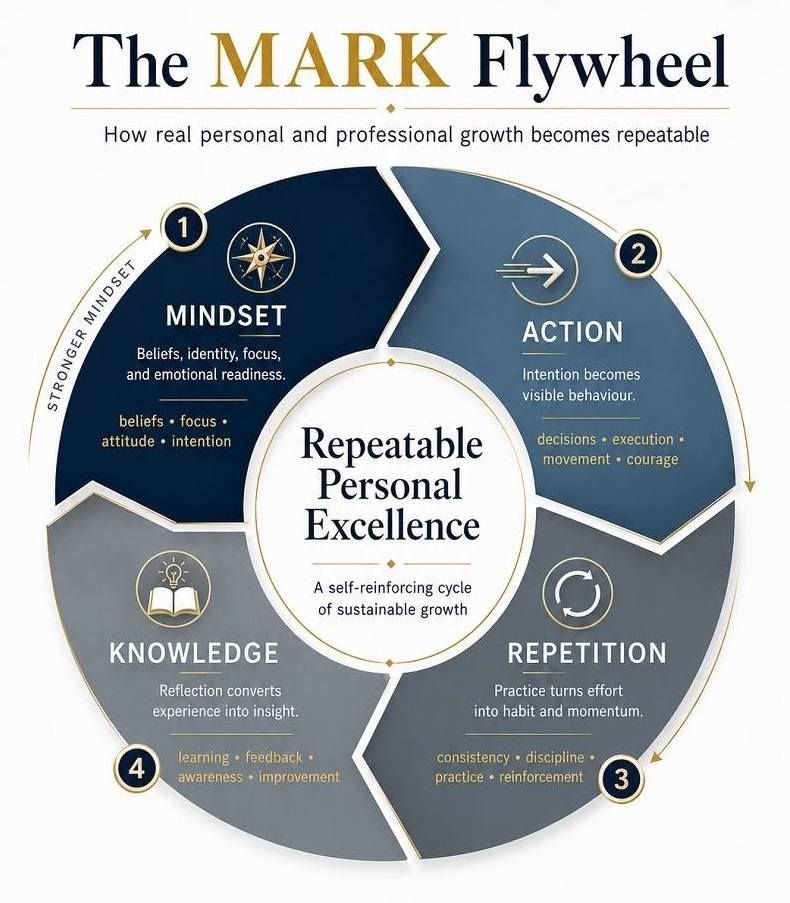
The two fit together closely. Mindset is the work at the upper floors — beliefs and identity,
where the cascade begins. Knowledge is capability, the floor where training belongs.
Action is behaviour, the floor where anything visible finally happens. And
Repetition is the answer to the question the levels raise and leave open: a shift at identity
creates the possibility of new behaviour, and repetition is what turns that possibility into something a person
does without deciding to.
MARK Model®Mindset · Action · Repetition · Knowledge
The MARK Model® — Mindset, Action, Repetition, Knowledge — and how a located difficulty becomes a changed one.
A Point Of Genuine Disagreement
What The Model Is Called, And What It Is Good For
The name has been contested for as long as the model has existed, and a reader deserves to know that before
somebody else tells them. “Logical levels” borrows a phrase from Bertrand Russell’s theory of logical types,
taken up by Gregory Bateson in his work on levels of learning, where it carries a precise technical meaning.
Critics within NLP — John Grinder among them — have argued that Dilts’s six levels are categories of experience
rather than logical types in that formal sense, and that the borrowed name claims a rigour the model has not
earned. Dilts’s own preferred term became neurological levels, which invites a separate question about
how tightly each level maps to the nervous system.
Both criticisms have force, and neither touches the part that works. What the model provides is a set of
distinctions sharp enough to stop a competent intervention being aimed a floor too low — and the difference
between hearing “I have never been shown how” and “I am not that sort of person” is real
whatever the six categories are called. Use it as a tool for locating and for choosing your next sentence. Ask
less of it than a formal hierarchy, and it will rarely let you down.
Where It Earns Its Place
Logical Levels At Work
Feedback That Can Be Acted On
Keep every piece of feedback at behaviour or capability and it becomes usable the same week. The single
most valuable habit on this page, and it costs one extra second of thought before speaking. Core to
leadership development.
The Training Request That Is Not About Training
A request for a course is a capability-level statement. Before you buy it, check whether the difficulty
lives a floor higher. A great deal of learning budget is spent answering a mismatched level politely.
The Change Programme That Stalls
New structures and new tools are environment-level moves. Where the resistance sits at identity —
this is not who we are — no amount of structure will settle it, and the programme will be blamed for
something it was never able to reach.
The Client Who Circles
A client returning to the same ground is often being met at the level they stated rather than one above it.
Locating the level is frequently the whole intervention. Trained in
ICF coach certification.
The Objection That Is Not About Price
“Too expensive” is a belief-level statement wearing an environment-level costume. Answering it with a
discount answers the costume. See
NLP sales training.
Writing A Purpose Statement Anybody Believes
Most fail because they were written at level six and never connected downward. A purpose that names no
behaviour and calls for no capability stays on the wall, admired and inert.
Refining The Skill
Where Logical Levels Goes Astray
You Climbed Too Far, Too Fast
Cause: The upper floors are more interesting. Fix: Meet the difficulty
where it was stated, then move one level. Answering a late report with a question about life purpose is
unwelcome, however accurate it may eventually prove.
You Treated Environment As An Excuse
Cause: Knowing that people attribute upward. Fix: Take the setting at
face value first and change what can be changed. Sometimes the room really is impossible, and dismissing that
costs you the credibility you need for the higher floors.
You Praised At Identity
Cause: Warmth reaches for the biggest compliment available. Fix: Praise
what was done. “You built that case well” strengthens; “you’re brilliant” is a verdict that has to be
defended from then on.
You Used The Levels As Labels
Cause: The model is satisfying to apply to other people. Fix: Levels
describe a statement in a moment, not a person. The same colleague speaks from four different floors before
lunch.
You Worked At Identity Without The Care It Asks For
Cause: The cascade is tempting. Fix: Identity work reshapes everything
below it, which is exactly why it belongs in a setting with trust already established and, where the material
is heavy, with a qualified professional.
You Located It And Stopped
Cause: Diagnosis feels like completion. Fix: Naming the floor is the
beginning. Something then has to be done there, and repeated, before anything at all is different.
Eighteen Questions Answered
NLP Logical Levels: Frequently Asked Questions
Every question, answered in full. Filter by what brought you here — or read all eighteen in order.
What Are Logical Levels In NLP?
Logical Levels is a model that sorts any situation into six layers — environment, behaviour, capability,
beliefs and values, identity, and purpose — so that effort can be aimed at the layer where the difficulty
actually sits. Each level answers a different question and calls for a different response, and the practical
skill is telling them apart while somebody is still speaking.
Who Created The Logical Levels Model?
Robert Dilts developed it in the mid-eighties, adapting Gregory Bateson’s work on levels of learning, which
Bateson in turn drew from Bertrand Russell’s theory of logical types. Dilts later added a sixth level above
identity, variously described as purpose, vision or belonging, as his work moved towards what he called third
generation NLP.
What Are The Six Levels In Order?
From the bottom: environment, meaning where, when and with whom; behaviour, meaning what is actually done;
capability, meaning the skills and strategies available; beliefs and values, meaning what is held true and
treated as important; identity, meaning who a person takes themselves to be; and purpose, meaning what the
whole thing serves beyond the individual.
Why Are They Called Neurological Levels?
Neurological levels became Dilts’s own preferred term, reflecting a proposal that each level engages
progressively more of the nervous system, with higher levels drawing on broader and more integrated systems
than a simple response to surroundings. The two names refer to the same six categories, and the second invites
a question about how tightly each level maps onto brain function.
What Is The Central Idea Behind The Model?
Direction. A change made at a higher level tends to reorganise everything below it, while a change made at a
lower level may leave the levels above entirely undisturbed. Someone whose sense of themselves shifts will
alter beliefs, skills, behaviour and surroundings without being asked. Someone given a quieter desk has a
quieter desk.
How Do I Tell Which Level Somebody Is Speaking From?
Listen to the grammar rather than the topic. “I am” and “we are” place a speaker at identity. “Always”,
“never” and “there is no point” place them at belief. “I don’t know how” places them at capability. A
description of specific actions is behaviour, and a description of the room, the tools or the timing is
environment.
What Is The Difference Between Behaviour And Capability?
Behaviour is what somebody did on one occasion. Capability is whether they can produce it reliably whenever
it is needed. Somebody who handled one difficult conversation well has demonstrated a behaviour; somebody who
handles them consistently has a capability. Training builds the second, and rehearsal and feedback build the
first.
What Is The Difference Between Beliefs And Identity?
A belief is something held to be true about a situation, such as “senior people pick presentations apart”.
Identity is a statement about the self, such as “I am not a presenter”. Beliefs can usually be examined and
updated within a conversation. Identity statements reorganise everything beneath them, which makes them more
powerful and more deserving of care.
Is A Higher Level Always Better To Work At?
No. Higher levels carry more influence and more cost, in time, discomfort and trust required. Where the
difficulty genuinely sits at environment, changing the environment is faster, cheaper and entirely sufficient.
The aim is accuracy rather than altitude: the right level, which is often lower than an enthusiastic
practitioner would prefer.
What Is Alignment, And How Do I Know It Is Missing?
Alignment means the levels support one another: what somebody does serves what they believe, which fits who
they take themselves to be, which serves something they find worthwhile. Misalignment shows up as effort
producing very little, as reluctance nobody can explain, or as a person performing well and feeling hollow
doing it.
How Do I Run The Alignment Walk?
Mark six spots in a line, one per level, and hold one situation in mind. Walk from environment upward,
speaking aloud at each: where and when, what you do, what skills you use, what you believe and value, who you
are at your best, and what this serves beyond you. Then turn and walk back down, carrying what you found at
the top through each level in turn, and finish by naming one action.
Why Give Feedback At The Level Of Behaviour?
Because behaviour can be repeated or altered, and a person is not available for either. Mueller and Dweck found across six
studies that children praised for being clever, rather than for what they did, later persisted less, enjoyed
the task less and performed worse after a setback than children praised for their effort. Identity-level
language installs something fragile even when it is warm.
How Do I Use This In A Team Or Organisation?
The same six levels apply: premises and tools, what people actually do, the skills available, what the
organisation believes and rewards, what it takes itself to be, and what it serves. Most stalled change
programmes are environment or behaviour interventions aimed at a difficulty living at belief or identity. Ask
which level a proposed change addresses before it is funded.
Yes, and the alignment walk was designed for exactly that. The useful discipline is writing down how you
describe the difficulty before you analyse it, since your own phrasing carries the level and it disappears the
moment you start tidying the sentence. Then ask what the level above is holding.
Is The Model Scientifically Established?
It is a practical framework rather than a validated theory, and it is best judged by whether it improves
your choices. The proposal that each level maps onto progressively broader neurological systems is not
established, and nothing on this page rests on it. What is well supported is the narrower and more useful
claim about language: the level a statement is aimed at changes how it is received and what can be done with
it.
Why Do Some People Object To The Name?
Because “logical levels” borrows a phrase from Bertrand Russell’s theory of logical types, taken up by
Bateson, where it carries a precise technical meaning. Critics within NLP, John Grinder among them, have argued
that the six levels are categories of experience rather than logical types in that formal sense. The objection
concerns the name and the claimed rigour rather than the practical distinctions.
When Should Identity-Level Work Be Handled Carefully?
Whenever the material is heavy, whenever trust has not been established, and whenever you are working with
somebody else rather than yourself. Identity work reshapes everything beneath it, which is its value and its
risk. In a workplace setting, keep the conversation at behaviour and capability, and let anything deeper belong
to a coaching relationship or a qualified professional.
Six levels take an afternoon to learn. Catching the floor somebody is speaking from in the middle of a sentence,
choosing the level to answer at, and doing identity work with the care it asks for — that is built with practice
and honest feedback. Train Logical Levels with an NLP Master Trainer on a
certified NLP programme,
or bring it to your organisation through
corporate training.