1
Read the two dials
Form a hypothesis: how direct is this culture with criticism, and how much do face and hierarchy matter? That sets your starting style.

The same sentence that motivates a German engineer can wound a Filipino supervisor and insult an Emirati manager. This is the UAE leader's guide to giving feedback that lands — community by community — built on the proven Culture Map framework and the Neuro-Linguistic Programming skill of reading the person in front of you.
Last updated: June 2026










You give feedback across cultures by adjusting two things to the person in front of you: how direct you are about the problem, and how carefully you protect their face and standing. Direct-feedback cultures want the issue stated plainly; indirect, high-face cultures need it private, softened, and wrapped in respect. Get those two dials right and the same message that would offend one person will motivate another.
The reliable method is to read the culture as a starting hypothesis, then calibrate to the individual using what you observe. At NLP Limited, that calibration is a trained Neuro-Linguistic Programming skill — which is how a manager flexes in the moment instead of memorising a rulebook.
Everything below describes tendencies commonly observed in business settings — not rules about any individual. A Chennai engineer and a Delhi engineer can differ as much as two nationalities; a British manager raised abroad may break every "British" pattern. Use these profiles as a first guess about what might land, then watch the person's actual reaction and adjust. The label gets you to the door; calibration gets you through it.
Decades of cross-cultural research — most clearly mapped in Erin Meyer's The Culture Map — show that cultures sit at very different points on how bluntly they give negative feedback. And, counter-intuitively, how explicit a culture is in everyday talk doesn't predict how direct it is with criticism. Americans speak plainly yet cushion criticism in praise; the British speak plainly yet bury criticism in understatement; Germans and the Dutch deliver it frank and unsoftened.
One linguistic tell makes this visible. Direct cultures use upgraders — words that strengthen criticism, like "absolutely," "totally," "strongly" ("this is completely unacceptable"). Indirect cultures use downgraders — words that soften it, like "kind of," "a little," "maybe," "perhaps" ("we're not quite there yet"). Miss the downgrader and you miss the message entirely.
How frankly does this culture state a problem? Direct cultures want it named plainly and standing alone; indirect cultures need it softened, gradual, and read between the lines.
How much does public standing and respect for rank matter? In high-face cultures, criticism in front of others can permanently damage trust, however gently it's worded.
A practical field guide to the communities you'll actually manage in the UAE. Each is a starting hypothesis to calibrate, not a verdict — and several nations, India above all, hold many distinct communities.
Honour and standing run deep. Give feedback privately and face-to-face — never by email or in front of others — and open with the relationship before the issue. Frame it as protecting a shared goal, not naming a failing."I value how you handle this client. Let's look together at tightening the reporting."
Warmer and more open to back-and-forth than Gulf norms — Lebanese, Syrian, Jordanian, Palestinian, and Egyptian colleagues often welcome discussion — but face still matters. Make it a two-way conversation inside a trusted relationship, kept private. A cold, one-way verdict lands badly.
Often comfortable with animated, relationship-driven exchange once trust exists, and highly responsive to a leader they respect as a mentor. Feedback works when it's personal and direct-but-warm. Purely cold, transactional criticism misses — the relationship carries the message.
Often more formal, reserved, and merit-and-logic oriented. Feedback lands best when it's private, specific, and evidence-based, respecting expertise. Give the data and the reasoning, not just the verdict; vague or emotional criticism erodes trust.
Relationship and trust over confrontation. Feedback framed around shared interest and the long-term working relationship is received well; status-threatening or public criticism is not.
Respect for seniority and personal honour runs strong across Pakistani, Bangladeshi, and Sri Lankan colleagues. Private, respectful feedback from a trusted senior is heard; public correction damages the relationship. Watch for a deferential "yes" that means "I hear you," not "I agree."
Public criticism is culturally damaging and can quietly destroy trust. Deliver feedback privately, frame it constructively, and use a gentle structure — appreciation, the specific issue, encouragement. Watch for "I'll try" or "yes," which can signal difficulty or acknowledgement, not commitment. Confirm understanding warmly, never with pressure.
Never criticise in public. Give negative feedback privately, softly, and gradually — let the message sink in over time rather than landing as a blunt verdict. A polite nod or silence may not mean agreement; create a private space for the real response.
Frank, explicit feedback that stands on its own — no sandwich, no cushioning. Over-softening makes them miss the point entirely. Criticism is about the work, not the person, and isn't taken personally. Be specific and direct; they'll respect it.
The classic trap: Britons sound polite while delivering real criticism through understatement. "That's an interesting approach" or "maybe we could…" can mean "this is wrong." Soften your own feedback to a Briton — but learn to decode their downgraders so you don't miss the message.
Plain about facts, but they wrap criticism in genuine praise. Open with specific appreciation, then move to the one change you want. Don't launch straight into criticism — it reads as harsh — and don't over-cushion when speaking to a German.
Comfortable with robust critique and intellectual debate. Well-reasoned, direct feedback is respected; vague praise is not. Expect — and allow — pushback as engagement, not defiance.
Generally relationship-driven, expressive, and respectful of seniority and elders, with directness that grows inside trust. Africa is a continent, not a culture — treat this only as a starting point and calibrate hard to the individual and nation.
Tendencies drawn from Erin Meyer's The Culture Map, Hofstede's cultural dimensions, and established intercultural workplace research — to be applied as hypotheses, not labels.
The situation: a team member missed a reporting deadline that affected the client. Here's the same feedback, re-shaped for three very different people.
"The client report was two days late and it caused a problem on their side. I need it submitted by the Wednesday deadline every cycle. What will you change to make that happen?"
Plain, specific, stands alone. No cushioning — it would only blur the point.
"You're doing well overall. One thing — the timing on the client report slipped a little this cycle, and it's quite important we hold the Wednesday date. Could we look at how to keep it on track?"
Downgraders soften it; the ask is clear but wrapped. Decode the same style coming back.
[In private] "I really appreciate the care you put into your work. I wanted to talk just with you — the client report timing has been tricky lately, and I'd like to help you protect the Wednesday deadline. How can I support you with that?"
Private, relationship-first, face protected. The fix is framed as shared support.
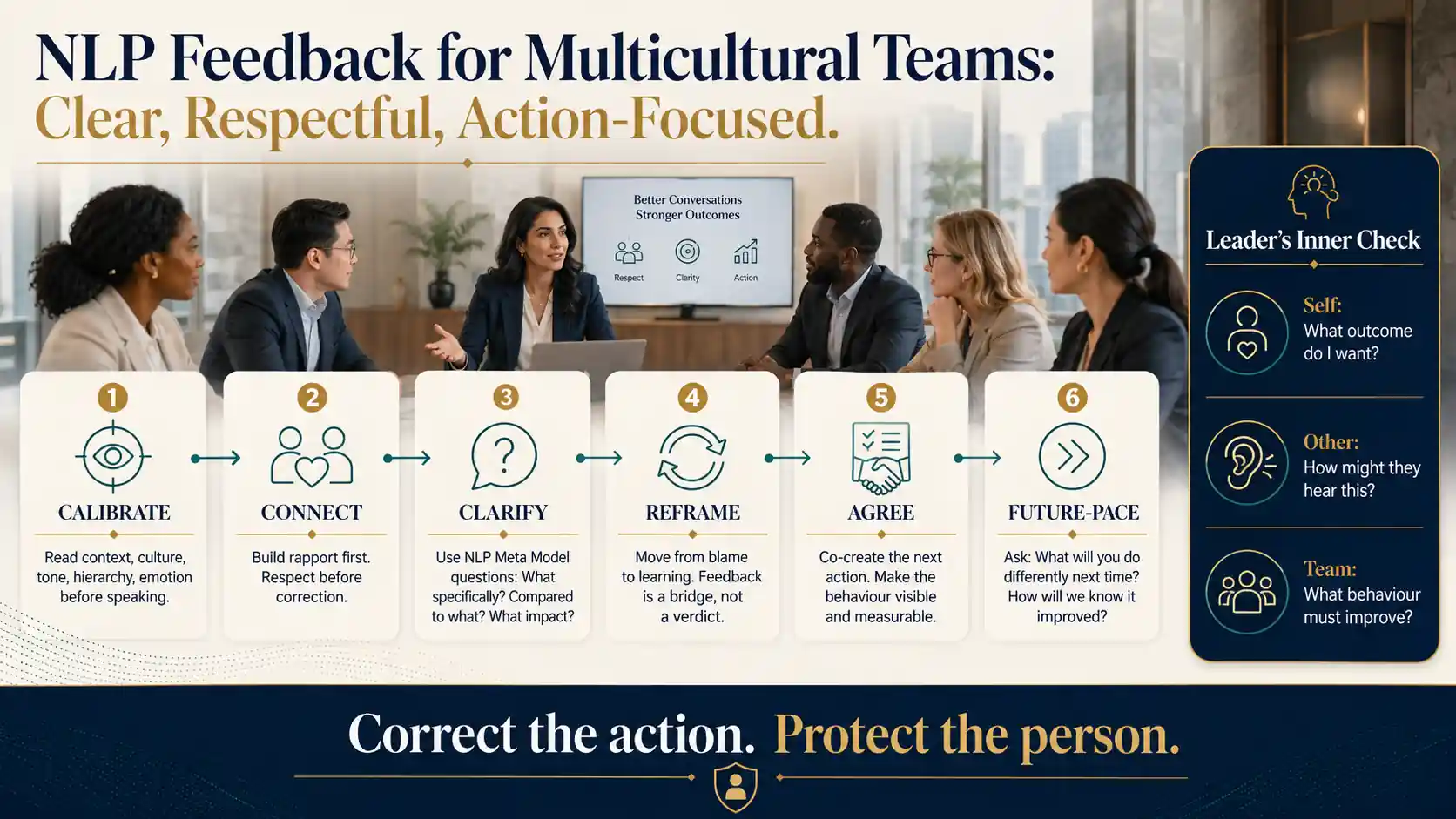
Profiles get you started; this method works across every culture, because it ends in calibrating to the real person.
Form a hypothesis: how direct is this culture with criticism, and how much do face and hierarchy matter? That sets your starting style.
When face or hierarchy is in play — which is most of the UAE — give corrective feedback one-to-one. Praise can be public; correction rarely should be.
Choose upgraders for direct cultures and downgraders for indirect ones. The words carry as much meaning as the message.
Critique the work and the impact, never the character. This protects face in every culture and keeps the conversation solvable.
A nod or a "yes" can mean "I hear you," not "I agree" or "I understood." Ask the person to say back the change in their own words.
Watch the real reaction and adjust. This is the trained NLP skill — reading the person and flexing — that turns the rulebook into instinct, reinforced through the MARK Model®.
| Move | What lands | What backfires |
|---|---|---|
| Setting | Private for correction, by default | Correcting someone in front of the team |
| Style | Matched to the person's dials | One blunt style for the whole team |
| Language | Upgraders or downgraders, chosen | Understatement a direct culture can't decode |
| The "sandwich" | Used for high-face cultures | Used on Germans, who miss the point |
| Checking | Ask them to say the change back | Assuming a polite "yes" means agreement |
| The skill | Calibrate to the individual | Treating the culture as a fixed box |
Rajiv Sharma has personally coached managers to give feedback across cultures in 57 countries — from Emirati boardrooms in Dubai and Abu Dhabi to multinational teams across India, Europe, Africa, and the USA. Every profile on this page has been pressure-tested in real rooms, with real managers who had a hard conversation to hold the next morning.

NLP Limited trains the cross-cultural feedback skill into your managers — in-house, in Dubai, Abu Dhabi, or virtually. Start with a conversation.

Rajiv Sharma is an NLP Master Trainer, ICF Professional Certified Coach (PCC), and founder of NLP Limited. Over 30+ years he has trained 850,000+ professionals across 57 countries, coaching leaders to communicate and give feedback across cultures. Certified under Dr Richard Bandler's Society of NLP and ranked #5 globally among NLP gurus by Global Gurus (2026), he is endorsed by Marshall Goldsmith, John Mattone, and Brian Tracy. More at RajivSharma.me.
Brian Tracy calls Rajiv "one of the top professional trainers and speakers in the world today." — Brian Tracy
Adjust two dials to the person: how direct you are about the problem, and how much you protect their face and standing. Direct cultures want it plain; indirect, high-face cultures need it private, softened, and respectful. As you read the person rather than the label, you'll notice exactly how much to flex — and the same message that once offended starts to land as support.
Separate the behaviour from the person, and they can hear the message without feeling attacked. Describe what you observed and its impact in specific, factual terms — "the report reached the client two days late" — never "you're careless." As you keep the focus on the work you both care about, notice how the defensiveness softens and the conversation turns toward the fix. Calibrate your pace to theirs, and it lands.
Lead with the relationship, then the truth. Open by making the shared goal explicit — "I want to see you do really well here" — so the honesty arrives as care, not criticism. When people feel the intention behind your words is for them, they relax, and the message goes deeper. Be clear and specific; the respect is in the precision, not in softening until the point disappears.
Make it a private, low-pressure conversation, and let questions do the work. Instead of delivering a verdict, ask — "how do you feel that went?" — and let them arrive at the change themselves, which feels safer and sticks longer. As the pressure drops, you'll see them open up. Keep your tone calm and your pace unhurried, and the conversation they were avoiding becomes one they can have.
Give them space and time, and resist filling the silence. After you share the point, pause — count slowly to five — and let them think; quieter, more reflective people often say the most important thing once the room goes still. Offer a written follow-up too, so they can respond in the channel where they're most fluent. Patience reads as respect, and respect opens them up.
Frame it as a shared interest and ask permission first — "may I share something I noticed?" — which honours their standing while opening the door. Keep it specific, factual, and free of judgement, and position yourself as helping rather than correcting. As you lead with respect, you'll find seniority stops being a barrier and the conversation becomes a collaboration between equals.
Don't rely on a nod or a "yes" — in many cultures that signals acknowledgement, not agreement or understanding. Ask the person to say back, in their own words, what they'll do differently. As they describe the change themselves, you'll both hear whether it truly landed — and the act of saying it out loud makes them far more likely to follow through.
Connect the change to something they already want. Start from their goal — growth, recognition, mastery — and frame the feedback as the bridge to it, so the message pulls them forward instead of pushing them down. Be specific about what good looks like, picture them getting there, and end on the next concrete step. People move toward a clear, desirable future far faster than away from a problem.
A polite "yes" often means "I hear you," not "I'll act." Slow down and make the commitment concrete and mutual: agree the specific change, the first step, and when you'll both check in. As they say the plan back in their own words, the vague agreement becomes a real one. Then follow up visibly — what gets reviewed gets done, and the pattern quietly shifts.
Prepare, then breathe and slow down. Before the conversation, get clear on the specific facts and the outcome you want, so you're anchored in purpose rather than emotion. Lower your pace and soften your tone — as your body stays calm, the other person's nervous system mirrors yours and settles too. Stay centred on the behaviour and the shared goal, and even a hard conversation stays steady.
The full guide to leading across 200+ nationalities.
Open the guide → MulticulturalResolve tension between employees from different cultures.
Open the guide → MulticulturalBuild the trust where people speak up and hear feedback.
Open the guide → CoreTurn feedback into coaching that develops people.
Open the guide →We turn cross-cultural feedback into a trained NLP skill — so your managers correct, develop, and retain people across every culture in the room.
Community profiles describe communication tendencies observed in business settings, not rules about individuals; always calibrate to the person. The MARK Model® is a registered framework of Rajiv Sharma (Govt. of India). Last updated June 2026.
Sources: Erin Meyer, The Culture Map: Breaking Through the Invisible Boundaries of Global Business (the Communicating and Evaluating scales; upgraders and downgraders); Geert Hofstede, cultural dimensions (power distance, individualism); and established intercultural workplace research on face, harmony, and high- vs low-context communication.