
Navi Pillay: Why She Won the 2026 Nobel Peace Prize and What Leaders Can Learn From Her
Navi Pillay, an 85-year-old South African judge of Indian origin, won the 2026 Nobel Peace Prize, announced in Oslo on 9 October 2026. Here is why the Norwegian Nobel Committee chose her, and what her six decades of work mean for anyone who leads.
Why Did Navi Pillay Win the 2026 Nobel Peace Prize?
Navi Pillay won the 2026 Nobel Peace Prize "for her efforts to promote peace and international law". The Norwegian Nobel Committee, announcing the award in Oslo on 9 October 2026, said the 85-year-old South African judge "has held states and national leaders accountable and brought hope to victims of violence and conflict", and called her "one of the great defenders of international legal principles in our time".
- The committee said Navi Pillay "has been instrumental in ensuring that war crimes, crimes against humanity and genocide are prosecuted", from the Rwanda tribunal to the International Criminal Court.
- It traced "a common thread" from her early work defending Nelson Mandela and other anti-apartheid activists to her later service as an international judge and as UN High Commissioner for Human Rights.
- The timing is deliberate. The committee warned that "the system of international law is under tremendous pressure, and its institutions are under attack".
- Navi Pillay is the fifth South African to win the Nobel Peace Prize and the first South African woman to do so.
- The prize is worth 12 million Swedish kronor (about US$1.2 million) and will be presented in Oslo on 10 December 2026.
- For leaders, the committee's reasoning matters because it rewards six decades of consistent behaviour rather than one act, and that behaviour can be learned. The six lessons are below.
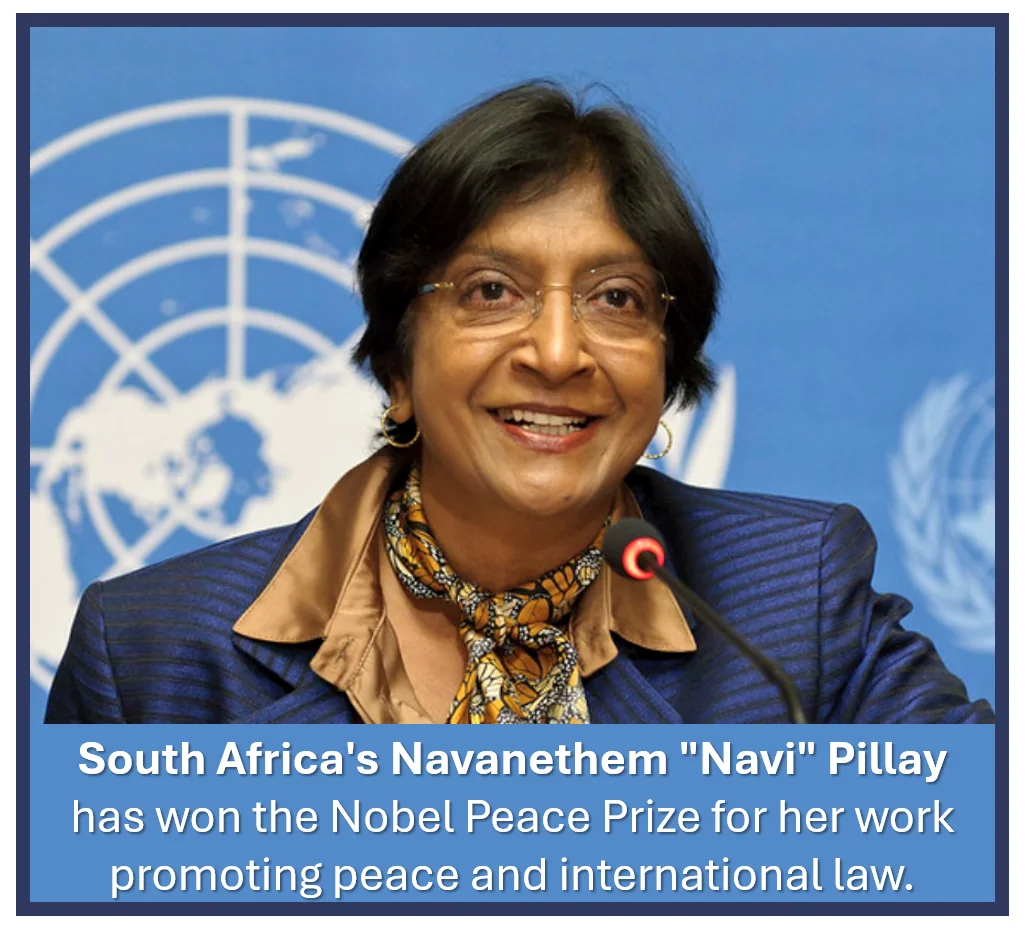
Most Nobel Peace Prizes go to people who stopped a war or started a movement. The 2026 prize went to a judge. That choice says as much about the state of the world in 2026 as it does about the woman who received it.
Navi Pillay has spent close to sixty years doing one thing: making the law reach people it was never designed to protect. Pillay did it first as a young advocate in apartheid Durban, and then for three decades on the international stage. She is still doing it today, at 85, as a judge at the International Court of Justice.
This article covers who Navi Pillay is, why the committee chose her, and what working leaders and coaches can take from her example. It is written for people who want substance rather than slogans.
The NLP Lens We Use to Read Leaders Like Navi Pillay
Neuro-Linguistic Programming began as the study of how exceptional people get their results, so that the patterns can be taught. That is the method behind the qualities and lessons in this article: watch what Navi Pillay actually does, name the pattern, and turn it into something a manager in Dubai, Mumbai or Lagos can practise on Monday morning.
Our NLP course teaches the four skills these lessons rest on:
- Modelling: breaking down how a high performer thinks and acts so the pattern can be learned by others.
- The Meta Model: precise questions that separate what was observed from what was assumed.
- Reframing: changing the frame on purpose so the organisation can see what it was missing.
- State management: staying composed when your work, or you, come under attack.
The course is delivered across the UAE, India and Nigeria by Rajiv Sharma, an NLP Master Trainer certified under Dr. Richard Bandler's Society of NLP.
Who Is Navi Pillay?
Navanethem "Navi" Pillay is a South African jurist of Indian origin, born in Clairwood, Durban, on 23 September 1941. In 1967 she became the first woman of colour to open a law practice in the province of Natal, and under apartheid she defended political detainees and helped win basic rights for prisoners on Robben Island. After 1994 she became the first woman of colour to sit as a judge on South Africa's High Court, then served as a judge and President of the International Criminal Tribunal for Rwanda, as a judge of the International Criminal Court, and as UN High Commissioner for Human Rights from 2008 to 2014. Navi Pillay currently sits as judge ad hoc at the International Court of Justice in the genocide case brought against Myanmar.
Navi Pillay at a Glance
| Full name | Navanethem "Navi" Pillay |
|---|---|
| Born | 23 September 1941, Clairwood, Durban, South Africa (age 85) |
| Nationality and heritage | South African, of Indian origin; her father drove a bus |
| Education | BA and LLB, University of Natal; Master of Laws (1982) and Doctor of Juridical Science (1988), Harvard Law School |
| Firsts | First woman of colour to open a law practice in Natal (1967); first woman of colour appointed an acting judge of South Africa's High Court (1995) |
| International roles | Judge, International Criminal Tribunal for Rwanda, 1995 to 2003 (President 1999 to 2003); Judge, International Criminal Court, 2003 to 2008; UN High Commissioner for Human Rights, 2008 to 2014 |
| Current role | Judge ad hoc, International Court of Justice, in The Gambia v. Myanmar genocide case |
| Recent work | Chair, UN Commission of Inquiry on the Occupied Palestinian Territory and Israel, 2021 to 2025 |
| Other honours | 2025 Sydney Peace Prize; 2026 Olof Palme Prize, shared with Professor John Dugard |
| Nobel Peace Prize | Announced 9 October 2026 in Oslo; fifth South African laureate and first South African woman; ceremony 10 December 2026 |
Why Did the Nobel Committee Choose Navi Pillay? Four Reasons
On Friday 9 October 2026 in Oslo, committee chair Jørgen Watne Frydnes read a citation that was short on words and long on history. Four threads run through it.
1Navi Pillay made accountability real: the 1998 Akayesu judgment
Navi Pillay joined the International Criminal Tribunal for Rwanda in 1995 and led it as President from 1999 to 2003. In the Akayesu judgment of 2 September 1998, the chamber she sat on ruled for the first time in legal history that rape could be an act of genocide.
The Akayesu ruling did not happen by accident. Sexual violence was present in the evidence but absent from the charges until the judges asked why. Pillay summed up the shift in 1998: "From time immemorial, rape has been regarded as one of the spoils of war. Now it will be considered a war crime."
2As UN human rights chief, Navi Pillay held governments to account
As UN High Commissioner for Human Rights from 2008 to 2014, Navi Pillay named abuses by governments large and small, often at a cost to her own standing with those governments. The committee said she "has held states and national leaders accountable and brought hope to victims of violence and conflict".
The committee also said Pillay "significantly enlarged the scope and impact of international law", first on the High Court in South Africa and later at the International Criminal Court.
3A single line from apartheid courtrooms to The Hague
The committee wrote that "a common thread runs from her early work defending Nelson Mandela and others who stood up against apartheid to her service as a judge in some of the key international court cases of our time". It called Navi Pillay "one of the great defenders of international legal principles in our time".
In other words, the prize is for consistency. The principles Pillay argued for as a young advocate who was barred from a judge's chambers are the ones she applied decades later from the bench.
4Why the committee chose Navi Pillay now
Frydnes told reporters that "the system of international law is under tremendous pressure, and its institutions are under attack", and that "we see a shift towards power politics at the expense of legal frameworks and global respect for law and justice".
The committee has used the prize before to shore up institutions it believes are threatened. Awarding it to a former judge of the International Criminal Court, a body sanctioned by the United States in 2020 and again from 2025, is a message as much as an honour.
What the Nobel Committee Said About Navi Pillay
- "The Norwegian Nobel Committee has decided to award the Nobel Peace Prize for 2026 to Navanethem 'Navi' Pillay for her efforts to promote peace and international law."
- "This year's laureate has significantly enlarged the scope and impact of international law."
- "Navi Pillay has held states and national leaders accountable and brought hope to victims of violence and conflict."
- "And yet, the system of international law is under tremendous pressure, and its institutions are under attack."
- "Her distinguished career reminds us of the need to support, fortify and expand the global rule of law."
- "Peace requires justice."
Navi Pillay's Life Story: From Clairwood to Oslo
- 1941: Born in Clairwood, Durban Navi Pillay is born into a working-class family of Indian origin in a segregated city. Her father drives a bus. When she wins a place to study law at the University of Natal, neighbours in her community collect money so she can take it up.
- 1967: The practice nobody would give her No law firm will take on a woman of colour, so Pillay opens her own, the first woman of colour in Natal to do so. Under apartheid rules she can appear in court but cannot enter a judge's chambers.
- 1970s: Defending the detained Pillay represents political detainees, including her own husband, Gaby Pillay, who is held under the Terrorism Act. Her casework exposes torture and helps establish basic rights for political prisoners on Robben Island, including access to lawyers.
- 1982 to 1988: Harvard Pillay earns a Master of Laws in 1982 and a Doctor of Juridical Science in 1988 from Harvard Law School, studying the system that excluded her until she understands it better than the people running it.
- 1995: Two appointments in one year President Nelson Mandela appoints Pillay an acting judge of the High Court, the first woman of colour on that bench. Months later the UN General Assembly elects her to the new International Criminal Tribunal for Rwanda, where she serves for eight years.
- 2003 to 2014: The Hague and Geneva Pillay is elected to the first ever panel of judges at the International Criminal Court and assigned to its Appeals Division. In 2008 she becomes UN High Commissioner for Human Rights, a post she holds for six years.
- 2021 to 2026: Still on the bench Pillay chairs the UN Commission of Inquiry on the Occupied Palestinian Territory and Israel, whose September 2025 report concludes that genocide has been committed in Gaza, a finding Israel rejects outright. She sits as judge ad hoc at the International Court of Justice in the case against Myanmar, receives the Sydney Peace Prize in November 2025 and the Olof Palme Prize in January 2026. On 9 October 2026, at the age of 85, Navi Pillay is awarded the Nobel Peace Prize.
"For her efforts to promote peace and international law." The official citation for Navi Pillay, Norwegian Nobel Committee, 9 October 2026
Leadership Qualities of Navi Pillay
Navi Pillay's leadership qualities, visible across six decades from a one-woman law office in Durban to the International Court of Justice, are moral courage, precision over volume, composure under attack, starting where she stood, the long view, and service to people without a voice. Strip away the titles and that pattern of behaviour explains the career. Every one of these qualities can be developed through deliberate leadership training and practice.
Moral Courage
Pillay took cases that could have cost her freedom under apartheid. Decades later, as UN human rights chief, she took positions that cost her goodwill with powerful governments. The risk changed. The behaviour did not.
Precision Over Volume
Pillay's influence has never come from the loudest voice in the room. It comes from evidence gathered carefully enough to survive hostile scrutiny. The Olof Palme Prize committee singled out exactly this quality.
Composure Under Attack
Pillay's findings have been dismissed as scandalous or political by governments on more than one continent. She has answered with the record rather than with the same heat.
Starting Where She Stood
When no firm would hire her, Pillay founded one. When the system excluded her, she learned it better than the people running it, and then went to Harvard to learn it better still.
The Long View
Six decades, one direction. Pillay is still sitting as a judge at 85, in a case that will take years to decide. Very few leaders hold a line that long.
Service to People Without a Voice
Pillay's clients were detainees under apartheid, and later the survivors of mass atrocity. The common factor is that none of them could have hired her at market rates.
Six Leadership Lessons from Navi Pillay
You will probably never sit in judgment on a genocide case. You will, this month, face a decision that tests whether you say what you see. Here is how Navi Pillay's example translates for executives and coaches.
1. Courage is built in small rooms before it is tested in big ones
Navi Pillay did not become brave at the United Nations. She practised courage in a one-woman law office in Durban, case by case, for years before anyone outside Natal knew her name.
2. Build your authority on evidence, not on your title
For most of her career Navi Pillay held no power that anyone was obliged to respect. What she held was a better record of the facts than the people opposing her. Positional authority runs out when you change roles. Evidence travels with you.
In NLP this discipline has a name. The Meta Model, taught in our Licensed NLP Practitioner Programme, is a set of precise questions for separating what was observed from what was assumed.
3. Ask the question nobody else is asking
In the Rwanda tribunal, the sexual violence was already in the witness testimony. It became part of the charges only because judges including Navi Pillay asked why it was missing. The frame you inherit decides what your organisation can see. A good executive coach earns their fee by asking the question the frame is hiding.
4. Leave the institution stronger than your tenure
Every role Navi Pillay held, she used to widen what the role could do, from the Rwanda tribunal's jurisprudence to the reach of the High Commissioner's office. None of it depended on her staying. That is the test of good corporate training too: capability that stays in the team after the trainer has gone.
5. Separate the attack on the finding from the attack on you
When a report of hers is called scandalous, Navi Pillay defends the method and the evidence. She does not defend her ego, because her ego was never the point. That discipline is the difference between a leader who is respected and one who is merely combative. It is also self-regulation, the part of emotional intelligence most senior leaders find hardest.
6. Keep the long view when the short view is noisy
At 85 Navi Pillay is working on a case that may outlast her. That is not stubbornness. It is a settled view that some outcomes are worth more than the time it takes to reach them.
Build the Leadership Qualities Navi Pillay Modelled
Courage and composure are capabilities, not personality traits. At NLP Limited we help leaders across the UAE, India, Nigeria and the wider Africa region develop exactly these through ICF-accredited coaching and leadership programmes.
Programmes That Build These Qualities
NLP Course: Neuro-Linguistic Programming Training
The foundation course. Modelling, the Meta Model, reframing and state management, taught by an NLP Master Trainer across the UAE, India and Nigeria.
Leadership Training Programmes
Courage and influence for managers and senior leaders, delivered in-house across the UAE, India and Africa.
Licensed NLP Practitioner Programme
Society of NLP certification. The Meta Model and reframing skills that underpin the lessons in this article.
Executive Coaching
One-to-one coaching for C-suite and senior leaders in Dubai, Abu Dhabi and online, with an ICF PCC coach.
ICF Coaching Certification
For leaders who want to coach their own teams, with an ICF-accredited pathway to credentialing.
Emotional Intelligence Training
Self-regulation and composure under pressure, built on the Goleman and Bar-On frameworks.
Corporate Training in Dubai and Abu Dhabi
The full range of NLP Limited programmes for teams, from sales training to graduate development.
Related Leadership Profiles
- Ratan Tata: Leadership Style, Qualities, Legacy and Life Story
- Sheikh Zayed: Leadership Style and Qualities
Frequently Asked Questions About Navi Pillay and the 2026 Nobel Peace Prize
Who won the Nobel Peace Prize in 2026?
Navanethem "Navi" Pillay, a South African judge and former UN High Commissioner for Human Rights, won the 2026 Nobel Peace Prize. The Norwegian Nobel Committee announced the award in Oslo on 9 October 2026 "for her efforts to promote peace and international law". She is the fifth South African laureate and the first South African woman to receive it.
Why did Navi Pillay win the Nobel Peace Prize?
Navi Pillay won the 2026 Nobel Peace Prize because, in the Norwegian Nobel Committee's words, she "has been instrumental in ensuring that war crimes, crimes against humanity and genocide are prosecuted" and "has held states and national leaders accountable". The committee also framed the award as a defence of international law at a time when its institutions are under attack.
Who is Navi Pillay?
Navi Pillay is a South African jurist of Indian origin. She opened the first law practice by a woman of colour in Natal in 1967, served as President of the Rwanda tribunal, as an International Criminal Court judge and as UN High Commissioner for Human Rights, and now sits as judge ad hoc at the International Court of Justice.
Is Navi Pillay Indian?
Navi Pillay is South African, not an Indian citizen. She was born in Durban in 1941 into a family whose forebears came to Natal from India, which makes her part of South Africa's Indian-origin community. That heritage is why her Nobel Peace Prize drew particular attention in India and across the Indian diaspora.
How old is Navi Pillay?
Navi Pillay is 85 years old. She was born on 23 September 1941 in Clairwood, Durban, South Africa, and had turned 85 two weeks before the Norwegian Nobel Committee announced her Nobel Peace Prize on 9 October 2026. She still sits as judge ad hoc at the International Court of Justice.
What did the Nobel Committee say about Navi Pillay?
The Norwegian Nobel Committee called Navi Pillay "one of the great defenders of international legal principles in our time" and said she "has held states and national leaders accountable and brought hope to victims of violence and conflict". It added that "the system of international law is under tremendous pressure, and its institutions are under attack".
How many South Africans have won the Nobel Peace Prize?
Five South Africans have won the Nobel Peace Prize. Navi Pillay, the 2026 laureate, is the fifth and the first South African woman. Before her came Albert Lutuli in 1960, Desmond Tutu in 1984, and Nelson Mandela and F.W. de Klerk, who shared the prize in 1993 for the peaceful end of apartheid.
What did Navi Pillay do at the Rwanda tribunal?
Navi Pillay served as a judge of the International Criminal Tribunal for Rwanda from 1995 and as its President from 1999 to 2003. In the Akayesu judgment of 2 September 1998, the chamber she sat on became the first international court to rule that rape could constitute an act of genocide.
How much is the 2026 Nobel Peace Prize worth and when is it presented?
The 2026 Nobel Peace Prize is worth 12 million Swedish kronor, roughly US$1.2 million. Navi Pillay will receive the medal and diploma at a ceremony in Oslo City Hall on 10 December 2026, the anniversary of Alfred Nobel's death, which is the fixed date for every Nobel Peace Prize presentation.
What can leaders learn from Navi Pillay?
Leaders can learn six things from Navi Pillay: build courage through daily practice rather than waiting for a defining moment, rest authority on evidence rather than title, ask the question the frame is hiding, strengthen the institution beyond your tenure, separate criticism of your work from criticism of you, and keep a long view when the short term is noisy.
Sources
- Norwegian Nobel Committee: Announcement of the Nobel Peace Prize 2026, 9 October 2026
- The National: Navi Pillay wins Nobel Peace Prize for promoting international law
- Al Jazeera: 2026 Nobel Peace Prize awarded to Navi Pillay
- CBS News: Nobel Peace Prize 2026 awarded to Navanethem "Navi" Pillay
- Bloomberg: Nobel Peace Prize goes to international jurist Navi Pillay
- France 24: South Africa's Navi Pillay wins 2026 Nobel Peace Prize
- ICTR: The Prosecutor v. Jean-Paul Akayesu, Judgement, 2 September 1998
- UN: Commission of Inquiry finds genocide in the Gaza Strip, 16 September 2025
- South African History Online: Navanethem (Navi) Pillay biography
- Sydney Peace Foundation: 2025 Sydney Peace Prize lecture by Navi Pillay, 6 November 2025
- Olof Palme Memorial Fund: 2026 Olof Palme Prize citation