Most businesses fail in Dubai not because the idea was weak or the market too small, but because of a few predictable, fixable patterns: too few qualified leads, weak differentiation, pricing that doesn't match perceived value, a poor online presence, the wrong target market, no repeat customers, or external market shifts. Commonly cited estimates put startup failure as high as 80% within two years. The cause is almost always one of those seven, and almost always fixable.
By Rajiv Sharma — NLP Master Trainer and creator of the MARK Model®. Ranked #5 globally by Global Gurus (2026). rajivsharma.me ↗
Last reviewed: June 2026
Dubai is busy and fiercely competitive at the same time, and that combination is what catches most owners out. A high-activity market doesn't hand you customers. It rewards the businesses that are easy to find, easy to choose, and easy to come back to. Most failures here aren't dramatic — they're small, predictable mistakes that compound until the runway disappears. Here are the seven that do the damage, the signs of each, and what actually changes it.
~80%
of new UAE startups don't survive their first two years
1.4M+
companies competing across the Emirates
90%+
of Dubai's businesses are SMEs
* Commonly cited industry estimates — directional, not official figures.
01 / LEADS
Why am I not getting enough qualified leads?
Leads don't arrive just because Dubai is large and active. Acquisition here is expensive, and most struggling businesses are either invisible to the right buyers or attracting the wrong ones. Often it's not the product — it's the pipeline.
Only a handful of inquiries a week
Plenty of website traffic that rarely converts
Revenue that depends almost entirely on word of mouth
FixPrecision over volume. Targeted marketing aimed at one segment beats broad advertising, and tracking the source of every lead stops you funding channels that never convert. This is the work behind digital marketing and strategy in Dubai.
02 / DIFFERENTIATION
Is weak differentiation costing me customers?
If a customer cannot tell in one sentence why they should choose you over the business next door, they default to price. In Dubai's crowded markets, price is a race you usually lose.
You can't state your value in a single sentence
Your pitch sounds like every competitor's
Customers keep asking for a discount
FixSharpen positioning and message so the better thing you do is felt, not buried in features. That is part strategy, part communication, and an outside perspective accelerates it. Start with a business coach for founders and leaders.
03 / PRICING
Are my pricing problems really about price?
Most pricing failures are not about the number. They are about value that was never communicated. Price too high without demonstrating worth and buyers walk. Price too low and you erode margin while signalling that your offer is cheap.
Thin or shrinking gross margins
You discount the moment a conversation stalls
Customers say "too expensive" before you've shown value
FixRepair the value story before the price. Framing worth in the buyer's own terms is a trained communication skill — exactly what Neuro-Linguistic Programming develops in a team.
04 / ONLINE PRESENCE
Is my online presence losing customers before they contact me?
Buyers in the UAE research online before they buy, and increasingly they screen options through AI-generated answers before a human is involved. A slow or dated site, a thin Google Business Profile, and few reviews cost you the deal before the first message.
Outdated, slow, or hard-to-use website
Few reviews and a weak Google Business Profile
Little visibility in search and AI results
FixTreat visibility and reputation as a system: a fast, credible website, active profiles, steady reviews, and content that answers real buyer questions so search and AI engines can surface you.
05 / TARGET MARKET
Am I targeting the wrong market?
Dubai's mix of nationalities, income levels, and industries tempts businesses to serve everyone. Serving everyone usually means resonating with no one.
You try to serve every nationality and income group
Your message stays vague to fit everyone
You can't name your single best customer
FixChoose one segment — luxury, SMEs, families, expats, tourists, or one industry — and build your offer, pricing, and channels around it. Clarity at the top changes everything below it.
06 / RETENTION
Why don't customers come back?
Acquisition is the expensive part. If customers buy once and disappear, you are refilling a leaking bucket. Increasing repeat business often grows revenue faster than chasing new customers.
You don't track what percentage of customers return
No referral system and no captured contact details
No follow-up after a sale
FixConsistent follow-up and real relationships — and consistency is a behaviour, not an intention. Our sales training in Dubai builds the rapport and post-sale habits that keep customers close.
07 / MARKET FORCES
How much of this is just the market?
Some pressure is external: rising competition, shifts in consumer spending, new regulations, seasonal swings, and changes in tourism or real estate activity. You can't control these forces, but you can read them earlier and adapt faster than competitors. The businesses that survive a downturn are rarely the ones with the biggest budget — they're the ones whose leaders moved while others waited.
The pattern behind the fixes
Most of these are behaviour problems, not knowledge problems
You already suspect which one is hurting you. The marketing that never got focused, the message that stayed vague, the follow-up that never became a system — these are things known and never installed.
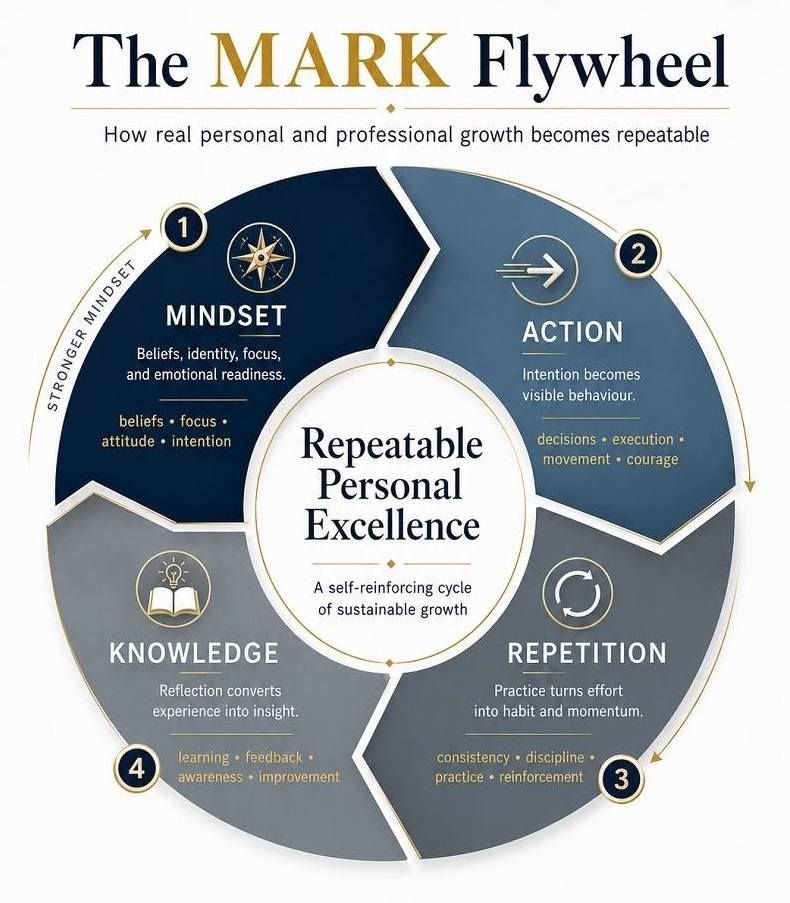
That gap between knowing and doing is why I built the MARK Model in 2013, now used by more than 850,000 professionals across 57 countries. It runs as a cycle: shift the Mindset, prove it with a specific Action, build it through Repetition until it's automatic, then turn the result into Knowledge that starts the next cycle higher.
M · MindsetA · ActionR · RepetitionK · Knowledge
The MARK Model® flywheel — Mindset, Action, Repetition, Knowledge.
Some of these take a quarter to fix properly. A few you can change immediately, and they tend to lift revenue from the traffic and customers you already have.
Make buying effortless. Add a WhatsApp contact, show your prices or starting prices, and cut steps from booking or checkout. In Dubai, speed and clarity convert.
Build proof. Collect reviews and complete your Google Business Profile, so buyers researching you find evidence, not silence.
Mine what you already have. Follow up with past customers and ask for referrals — the warmest, cheapest pipeline you own.
Answer real questions publicly. Put the questions buyers actually ask on your site, so search and AI engines surface you when they look.
A practical diagnostic
Find your real bottleneck
I would rather find the problem than guess at it. Share these five things and I can point to the most likely cause and a specific plan:
What your business does
How long you have been operating
Your monthly revenue range
How customers currently find you
Your biggest challenge: few leads, low sales, thin profit, or high costs
Frequently asked questions
What percentage of businesses fail in Dubai?
Commonly cited figures suggest a large share of new UAE businesses don't survive their first few years, with some estimates putting startup failure near 80% within two years. Treat these as directional, not official. What matters more is that most failures trace to a few fixable patterns, not a weak idea or a bad market.
Why is my business struggling when Dubai's economy is strong?
A strong market doesn't hand you customers; it raises competition. Most struggling Dubai businesses lose on visibility, differentiation, or retention rather than on demand. The market is rarely the real reason, even when it feels like it.
Why am I not getting leads in Dubai?
Usually it's not your product, it's your pipeline. In a market with over a million companies competing, you have to show up where buyers research and give them a clear reason to choose you. Broad advertising and word of mouth alone rarely produce steady, qualified leads here.
Why is my website not generating leads?
If your site brings traffic but no inquiries, the problem is rarely the market. It's usually positioning, search visibility, page speed, or a weak path to action. A site that doesn't load fast, rank, or make contact effortless loses buyers before they ever reach you.
Why aren't my leads converting?
Low conversion is usually a system problem, not a traffic problem. Leads arrive unqualified, follow-up is slow or generic, and the sales conversation doesn't match what the buyer needs. Tighten qualification and follow-up before spending more on ads.
Why do customers only choose the cheapest option?
When buyers can't tell what makes you different, price becomes the only thing left to compare. That's a differentiation and value-communication gap, not a sign your market is cheap. Make the outcome you deliver obvious, and price stops being the whole conversation.
Is my problem marketing or sales?
If qualified leads aren't arriving, the leak is demand and presence — a marketing and strategy issue. If leads arrive but stall, the leak is conversion — a sales-skill issue. Diagnose which layer is broken before adding budget to the other.
How can I increase sales quickly in Dubai?
Start by making buying effortless: add a WhatsApp contact, show prices, and cut steps from booking or checkout. Then follow up with existing customers and ask for referrals. These convert the traffic and trust you already have, often faster than chasing new leads.
Let's find your bottleneck together
Bring us your numbers, and we'll show you where the leak is
If your numbers are slipping and you're not sure why, the cause is usually one fixable pattern — and it's rarely where owners look first. Send us the five answers above and we'll identify the most likely bottleneck and a specific plan for your business in Dubai.
Prefer to read first? Depending on where the leak is — demand, conversion, or strategy — the contextual links above point you to the right NLP Limited program.
About the author
Rajiv Sharma is an NLP Master Trainer, executive coach, and the creator of the MARK Model®. NLP Limited has trained over 850,000 professionals across 57 countries. More at rajivsharma.me ↗.
Your form has been successfully submitted.
Course will be emailed to you in 24 hours.