

Dubai is close to winning a race most cities have not started lacing up for. When a whole city learns to operate the same tool, operating that tool stops being an advantage. It becomes the floor.
So the question changes. Not “can you use AI?” but “should you trust what it just told you?”
That second question is human judgment. It is the real skill gap. And it is exactly what Neuro Linguistic Programming was built to train.
Why NLP is the judgment skill of the AI era
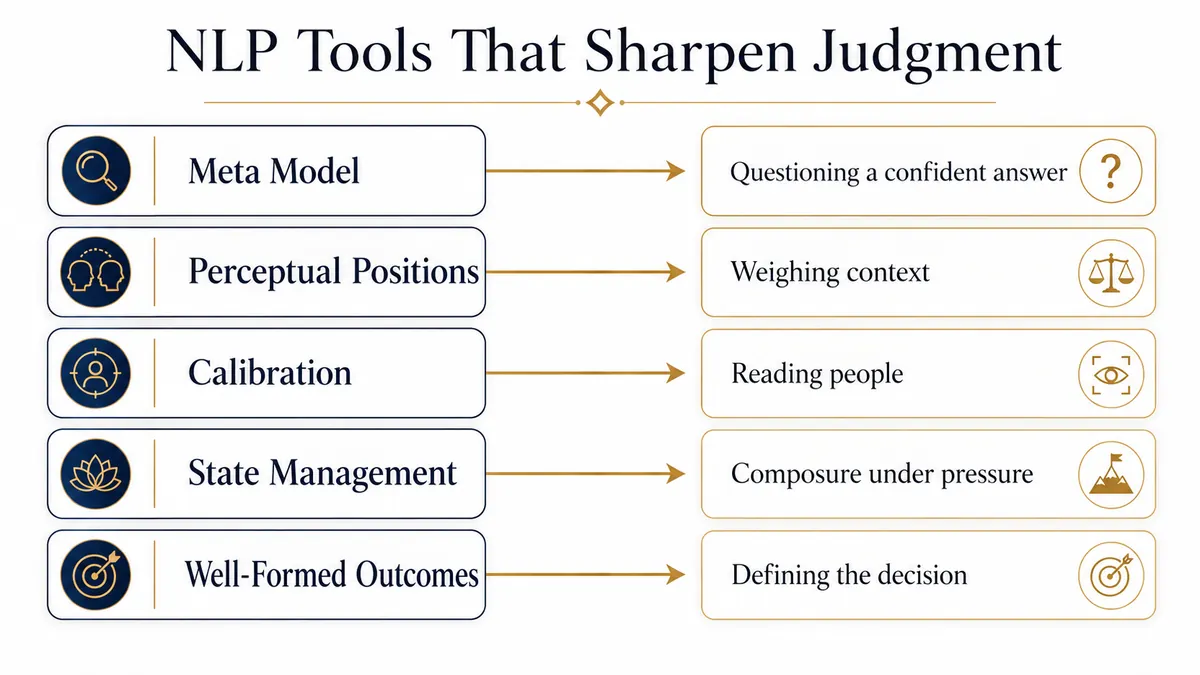
Judgment is not a personality trait you are born with. It is a trainable skill, and NLP is one of the few disciplines designed to train it directly. Where AI hands you a fast, confident answer, NLP gives you the means to interrogate that answer before you act on it:
- The Meta Model teaches you to question vague or assumed language. It is the same instinct that catches a confident AI answer built on a quietly wrong premise.
- Perceptual positions train you to read a decision from three angles at once: your own, the other person's, and a detached observer's. That is how you weigh the context a model never sees.
- Calibration and sensory acuity sharpen how you read the people in the room, the signal AI has no access to.
- State management lets you decide under pressure without sliding into panic or autopilot.
- Well-formed outcomes force you to define what a decision must actually achieve before you reach for a tool to help you make it.
Literacy operates the machine. NLP decides whether to believe it.
Why AI literacy is becoming a commodity
- Skill shelf life is falling from fifteen years to six (Dubai Jobs of the Future report, DET and KHDA, April 2025).
- Skills for AI-exposed jobs are changing 66 percent faster than skills in other professions (PwC, 2025).
- A whole workforce is reskilling toward the same competence at the same time.
There is a law underneath markets that policy does not bend. When the supply of a skill floods, its price falls. AI literacy is heading toward ubiquity, and ubiquity is the opposite of advantage.
In 2026, knowing how to prompt a model well sits roughly where knowing how to use a search engine sat in 2010. Necessary. No longer rare.

What human judgment actually means
Human judgment is the ability to decide what a situation truly needs, to tell a sound answer from a merely confident one, and to carry the consequence of that decision. AI generates options at speed. It cannot be held accountable for choosing the wrong one. You can.
- Harvard's Institute for Business in Global Society (2025) found today's AI cannot reliably tell a strong idea from a mediocre one.
- The LSE Business Review put it plainly: in complex decisions, context and human insight are where a machine cannot stand in for a person.
Picture a procurement lead at a Dubai logistics firm. Her system returns a clean recommendation: switch suppliers, save eleven percent. The math is almost certainly right.
The model knows nothing about the supplier who came through during a port closure two years ago, or the relationship that buys her team goodwill when a shipment runs late. Her job is to weigh the eleven percent against everything the model could not see. That weighing is judgment, and no amount of prompt fluency produces it.

Why judgment is scarce, not obvious
From the World Economic Forum's Future of Jobs Report 2025:

- Analytical thinking is the single most sought-after core skill, called essential by seven in ten companies.
- Resilience, leadership and social influence, and empathy rank right behind it.
- AI and big data are the fastest-growing technical skills, yet the report is blunt that technical skill is necessary and not sufficient.
- 39 percent of a worker's core skills will change by 2030.
The skills forecast to stay scarce are the ones a model cannot perform for you: reading a room, holding a position under pressure, choosing what belongs on the table in the first place.
The trap hidden inside the AI boom
Here is the part almost no one says out loud. The more fluent you become with AI, the more your judgment is at risk of weakening. The mechanism has a name: cognitive offloading.
- SBS Swiss Business School (2025, journal Societies): heavier AI use is linked to lower critical thinking scores, with offloading sitting in the middle of that link.
- MIT (2025, using EEG scans): measurably lower brain engagement in people who leaned on ChatGPT to write.
- Microsoft research with knowledge workers: higher confidence in AI tracked with less effortful thinking.
Judgment is built through reps: forming your own view of a problem before you see the answer, defending a recommendation in your own words, and sitting with a hard call long enough to feel its weight. A capable model removes every one of those reps.
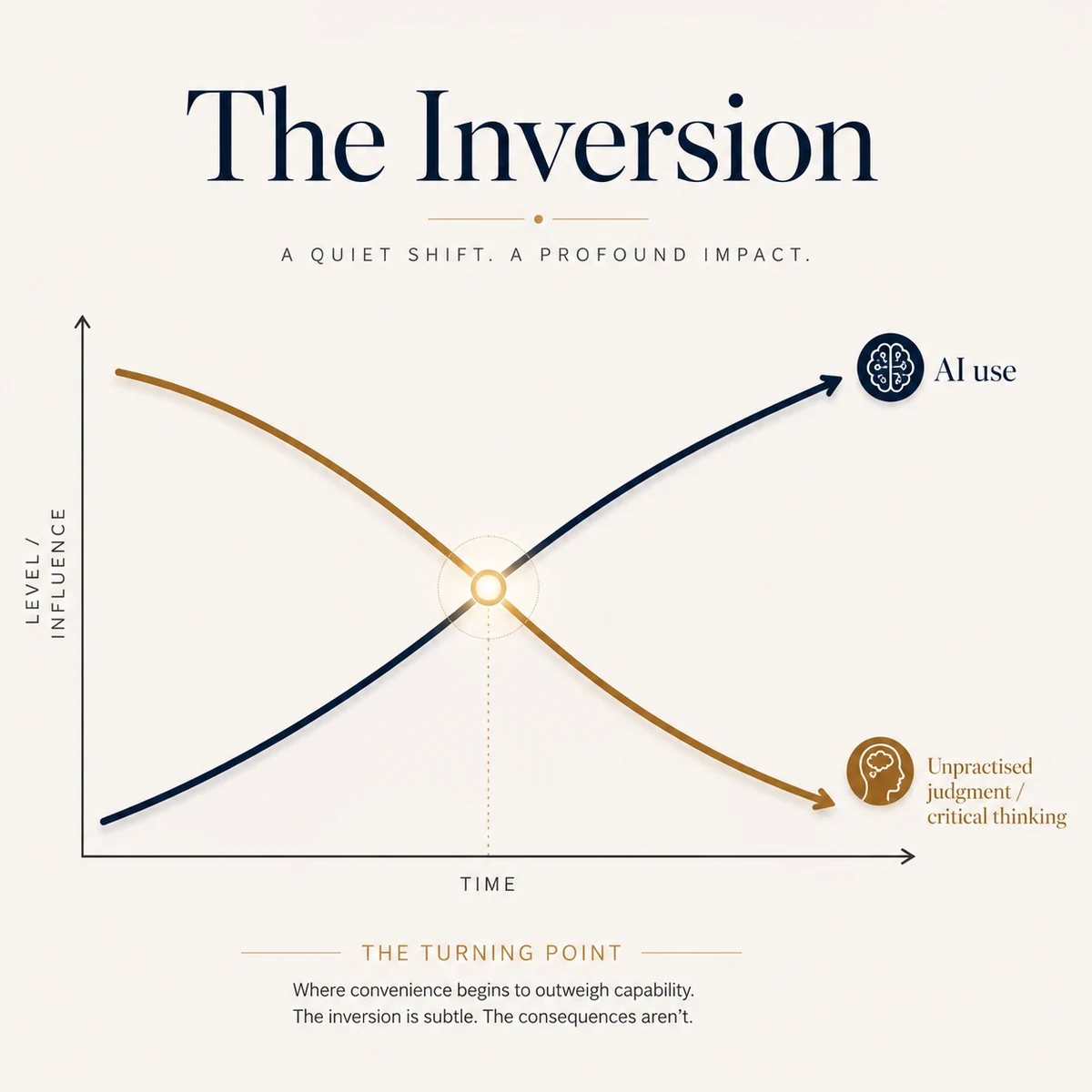
The better AI gets at producing a confident answer, the more valuable the human ability to disagree with it becomes.
And the more we use AI, the less we practise disagreeing. The most fluent city is, for that exact reason, the most exposed. Dubai's strength contains its risk.
AI literacy vs human judgment
| AI literacy | Human judgment | |
|---|---|---|
| What it is | Operating AI tools to get useful output | Deciding whether that output is right and owning the result |
| How you build it | Courses, certifications, daily tool practice | Repeated decisions with real stakes, honest feedback, and NLP training |
| Where it's heading | Toward ubiquity, taught from kindergarten up | Still rare, and quietly eroding under heavy tool use |
| What it's good for | Speed, drafts, options, pattern-finding | Choosing well, reading context, carrying consequence |
| When it's missing | You fall behind on output | You make fast, plausible, confident mistakes |
How Dubai can close the judgment gap
UAE leaders are already pointed the right way:
- 84 percent of UAE CEOs plan to grow their workforce over three years (KPMG Middle East CEO Outlook, 2025).
- 80 percent are redesigning roles around AI rather than under it.
The work now is to redesign roles in a way that protects judgment instead of automating it away:
- Decide before you ask. Form a position on the problem first, then bring in the model to test it, not to hand you a starting point. The order is the difference between a colleague and a crutch.
- Make people defend it. If a recommendation is AI-assisted, ask for it argued in plain words, tradeoffs included. A person who cannot defend a call did not make it.
- Put people on decisions that carry weight. Judgment grows in the presence of consequence and almost nowhere else.
- Reward the sharp question over the fast answer. A workplace that prizes speed teaches offloading. One that prizes the missing factor teaches judgment.
This is not new thinking for us. It is the Repetition pillar of the MARK Model I built in 2013: Mindset, Action, Repetition, Knowledge. Judgment, like any habit worth keeping, is installed through deliberate repetition, not one flash of insight. The reps are the training.
None of this is a vote against AI. Use it everywhere it earns its place. But the team that can question the machine will always be worth more than the team that can only operate it. NLP is how you train people to question the machine.
Frequently asked questions
Will AI replace jobs in Dubai?
Some routine roles will shrink, but UAE employers are mostly hiring. In KPMG's 2025 outlook, 84 percent of UAE CEOs planned to grow headcount over three years, and 80 percent are redesigning roles around AI. The real risk is a workforce fluent in AI but short on the judgment to use it well.
What skills should I learn to stay relevant in Dubai's job market?
Treat AI literacy as the baseline, then build the skills a model cannot perform for you: analytical thinking, judgment, leadership, and resilience. The World Economic Forum ranks analytical thinking the top core skill for 2025, essential to seven in ten employers. The scarce, durable edge is deciding well, not prompting fast.
Can AI make better decisions than humans?
AI is strong at producing options and spotting patterns, weak at choosing between them in a real human context. A 2025 Harvard study found today's AI cannot reliably tell a strong idea from a mediocre one. It can inform a decision. It cannot own the consequence of the wrong one. You can.
What is the difference between AI literacy and human judgment?
AI literacy is operating the tools to get useful output. Human judgment is deciding whether that output is right, weighing what the model could not see, and carrying the result. Literacy is becoming common across Dubai. Judgment is becoming rare, which is exactly what makes it valuable.
Does using AI too much reduce critical thinking?
Evidence is mounting that it can. A 2025 SBS Swiss Business School study linked heavier AI use to lower critical thinking scores through cognitive offloading, and an MIT EEG study found reduced brain engagement in people who leaned on ChatGPT to write. The skill weakens through disuse, like an unworked muscle.
Is NLP still relevant in the age of AI?
More than ever. NLP trains the exact skills AI erodes: questioning a confident answer with the Meta Model, weighing other viewpoints through perceptual positions, and reading people through calibration. As tools take over routine thinking, the discipline of thinking on purpose becomes the rarer, more valuable capability.
How can I future-proof my career in the UAE?
Learn the tools, then out-think them. Become genuinely useful at the decisions AI cannot own: judgment, leadership, reading people, handling pressure. With the average skill shelf life falling from fifteen years to six (Dubai Jobs of the Future, 2025), the durable asset is not what you know. It is how well you decide.
Which skills will be most in demand in Dubai by 2030?
A baseline of AI literacy, plus the human skills that decide outcomes: analytical thinking, judgment, leadership, and resilience under pressure. The World Economic Forum estimates 39 percent of core skills will change by 2030, and the ones that last are those a model cannot perform on your behalf.

About the author
Rajiv Sharma
Rajiv Sharma is an NLP Master Trainer, ICF Professional Certified Coach (PCC), and the creator of the MARK Model®. Ranked among the world's Top 5 NLP thought leaders by Global Gurus, he has trained and coached 850,000+ professionals across 57 countries since 2000. He is the author of Make a MARK in Life, AI-Powered Sales Success, and LeadFORTH, and the creator of the AI-ENABLE Framework®, LeadFORTH®, and the Mirrorwalk Method. His work has been endorsed by Brian Tracy, Marshall Goldsmith, and John Mattone. Based in Dubai, he helps leaders and teams build the judgment, decision-making, and behavioural change that AI cannot replace.
More from Rajiv: rajivsharma.me · LinkedIn · YouTube · Instagram